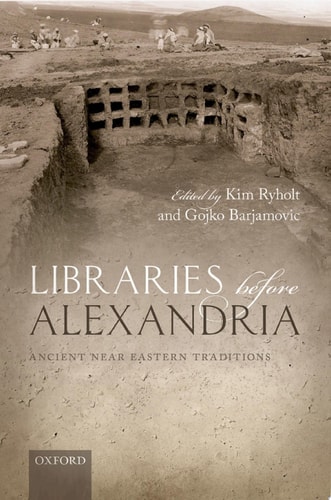
Libraries before Alexandria: Ancient Near Eastern Traditions
0
0
As an Amazon Associate and affiliate partner, Menrva Books earns from qualifying purchases. Learn more
Author Description
The creation of the Library of Alexandria is widely regarded as one of the great achievements in the history of humankind - a giant endeavour to amass all known literature and scholarly texts in one central location, so as to preserve it and make it available for the public. In turn, this event has been viewed as a historical turning point that separates the ancient world from classical antiquity. Standard works on the library continue to present the idea behind the institution as novel and, at least implicitly, as a product of Greek thought. Yet, although the scale of the collection in Alexandria seems to have been unprecedented, the notion of creating central repositories of knowledge, while perhaps new to Greek tradition, was age-old in the Near East where the building was erected. Here the existence of libraries can be traced back another two millennia, from the twenty-seventh century BCE to the third century CE, and so the creation of the Library in Alexandria was not so much the beginning of an intellectual adventure as the impressive culmination of a very long tradition. This volume presents the first comprehensive study of these ancient libraries across the 'Cradle of Civilization' and traces their institutional and scholarly roots back to the early cities and states and the advent of writing itself. Leading specialists in the intellectual history of each individual period and region covered in the volume present and discuss the enormous textual and archaeological material available on the early collections, offering a uniquely readable account intended for a broad audience of the libraries in Egypt and Western Asia as centres of knowledge prior to the famous Library of Alexandria.
Menrva's Summary
THE THESIS
This volume investigates the historical origins of knowledge repositories, challenging the notion that the Library of Alexandria was a unique invention of Greek thought. Edited by Gojko Barjamovic and Kim Ryholt, the work compiles research from leading specialists to demonstrate that the concept of the central library was a well-established practice in the Near East for two millennia prior to the Alexandrian institution. By examining textual and archaeological evidence, the authors argue that the Library of Alexandria represents the culmination of a long-standing tradition rather than a singular intellectual departure.
THE SCOPE MAP
What You Will Find
- Analysis of library systems spanning from the twenty-seventh century BCE to the third century CE.
- Comparative studies of institutional knowledge centers in Egypt and Western Asia.
- Synthesis of archaeological findings and textual records regarding early writing and record-keeping.
Scope Limits
- The text focuses primarily on the Near East and Egypt, excluding later medieval or modern library developments.
- It does not provide a detailed biography of the individual scholars involved in the Alexandrian project.
THE AUTHORITY PERSPECTIVE
Experts recognize this volume as a significant contribution to the field of intellectual history for its comprehensive re-evaluation of ancient archival practices. Readers frequently note that the prose remains accessible to a broad audience while maintaining the academic rigor expected of a specialized historical study.
Page Count:
511
Publication Date:
2019-01-01
Publisher:
OUP Oxford
ISBN-10:
0192523996
ISBN-13:
9780192523990
History
Middle Eastern
Libraries
Ancient History
Middle East
Intellectual History
Near Eastern Studies
Archaeology
Community Tags
Similar Books