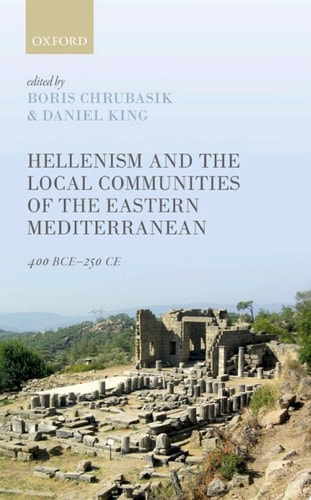
Hellenism and the Local Communities of the Eastern Mediterranean: 400 BCE-250 CE
0
0
As an Amazon Associate and affiliate partner, Menrva Books earns from qualifying purchases. Learn more
Author Description
Hellenism and the Local Communities of the Eastern Mediterranean offers a timely re-examination of the relationship between Greek and non-Greek cultures in this region between 400 BCE and 250 CE. The conquests of Alexander the Great and his Successors not only radically reshaped the political landscape, but also significantly accelerated cultural change: in recent decades there has been an important historiographical emphasis on the study of the non-Greek cultures of the Eastern Mediterranean, but less focus on how Greek cultural elements became increasingly visible. Although the process of cross-cultural interaction differed greatly across Asia Minor, Egypt, the Levant, and Mesopotamia, the same overarching questions apply: why did the non-Greek communities of the Eastern Mediterranean engage so closely with Greek cultural forms as well as political practices, and how did this engagement translate into their daily lives? In exploring the versatility and adaptability of Greek political structures, such as the polis, and the ways in which Greek and non-Greek cultures interacted in fields such as medicine, literature, and art, the essays in this volume aim to provide new insight into these questions. At the same time, they prompt a re-interrogation of the process of Hellenization, exploring whether it is still a useful concept for explaining and understanding the dynamics of cultural exchange in the Eastern Mediterranean of this period.
Menrva's Summary
THE THESIS
This volume investigates the mechanisms and motivations behind the adoption of Greek cultural and political practices by non-Greek communities in the Eastern Mediterranean between 400 BCE and 250 CE. Edited by Boris Chrubasik and Daniel King, the work compiles a series of scholarly essays that challenge traditional historiographical models of Hellenization. By analyzing regional variations across Asia Minor, Egypt, the Levant, and Mesopotamia, the contributors argue for a more nuanced understanding of cross-cultural exchange that moves beyond simple assimilation narratives.
THE SCOPE MAP
What You Will Find
- Analysis of political structures such as the polis in non-Greek contexts.
- Investigations into cultural integration within medicine, literature, and art.
- Comparative regional studies covering Asia Minor, Egypt, the Levant, and Mesopotamia.
Scope Limits
- The text does not provide a comprehensive political history of the Successor kingdoms.
- It does not focus on the military history of the period.
THE AUTHORITY PERSPECTIVE
Scholars view this collection as a significant contribution to the ongoing debate regarding the utility of the term 'Hellenization' in modern historiography. The text is noted for its academic rigor and is primarily intended for researchers and students of the ancient Mediterranean world.
Page Count:
254
Publication Date:
2017-01-01
Publisher:
OUP Oxford
ISBN-10:
0192528203
ISBN-13:
9780192528209
History
English & College Success
Hellenism
English
Cultural History
Ancient History
Mediterranean History
Community Tags
Similar Books