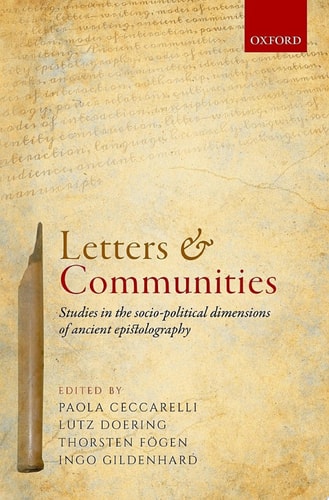
Letters and Communities: Studies in the Socio-Political Dimensions of Ancient Epistolography
0
0
As an Amazon Associate and affiliate partner, Menrva Books earns from qualifying purchases. Learn more
Author Description
The writing of letters often evokes associations of a single author and a single addressee, who share in the exchange of intimate thoughts across distances of space and time. This model underwrites such iconic notions as the letter representing an 'image of the soul of the author' or constituting 'one half of a dialogue'. However justified this conception of letter-writing may be in particular instances, it tends to marginalize a range of issues that were central to epistolary communication in the ancient world and have yet to receive sustained and systematic investigation. In particular, it overlooks the fact that letters frequently presuppose and were designed to reinforce communities-or, indeed, to constitute them in the first place. This volume explores the interrelation of letters and communities in the ancient world, examining how epistolary communication aided in the construction and cultivation of group-identities and communities, whether social, political, religious, ethnic, or philosophical. A theoretically informed Introduction establishes the interface of epistolary discourse and group formation as a vital but hitherto neglected area of research, and is followed by thirteen case studies offering multi-disciplinary perspectives from four key cultural configurations: Greece, Rome, Judaism, and Christianity. The first part opens the volume with two chapters on the theory and practice of epistolary communication that focus on ancient epistolary theory and the unavoidable presence of a letter-carrier who introduces a communal aspect into any correspondence, while the second comprises five chapters that explore configurations of power and epistolary communication in the Greek and Roman worlds, from the archaic period to the end of the Hellenistic age. Five chapters on letters and communities in Ancient Judaism and Early Christianity follow in the third, part before the volume concludes with an envoi examining the trans-historical, or indeed timeless, philosoph
Menrva's Summary
THE THESIS
How does the practice of ancient letter-writing function as a mechanism for constructing and reinforcing social, political, and religious communities? The editors, Lutz Doering, Paola Ceccarelli, and Thorsten Fögen, compile multi-disciplinary research to challenge the traditional view of the letter as a purely private, dyadic exchange. By analyzing epistolary communication through the lens of group identity, the contributors argue that letters served as essential tools for maintaining cohesion and authority across the ancient Mediterranean world.
THE SCOPE MAP
What You Will Find
- Theoretical frameworks regarding epistolary discourse and group formation
- Analysis of the role of letter-carriers in communal communication
- Case studies spanning Greece, Rome, Judaism, and Early Christianity
- Investigations into power dynamics and identity construction from the archaic period through the Hellenistic age
Scope Limits
- The volume does not provide an exhaustive survey of all ancient epistolary traditions
- It excludes detailed linguistic analysis of individual letter styles in favor of socio-political functions
THE AUTHORITY PERSPECTIVE
Scholars recognize this volume as a significant contribution to the study of ancient communication networks and social history. Experts highlight the text for its successful integration of diverse cultural perspectives and its rigorous theoretical approach to the study of epistolary documents.
Page Count:
384
Publication Date:
2018-01-01
Publisher:
OUP Oxford
ISBN-10:
0192526235
ISBN-13:
9780192526236
History
Epistolography
Sociology
English
English & College Success
Ancient History
Special Topics
Community Tags
Similar Books












Reader Comments
Share Your Thoughts
No comments yet. Be the first to share your thoughts!