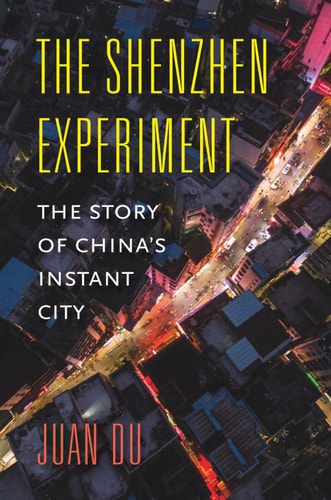
The Shenzhen Experiment
0
0
As an Amazon Associate and affiliate partner, Menrva Books earns from qualifying purchases. Learn more
Author Description
An award-winning Hong Kong–based architect with decades of experience designing buildings and planning cities in the People’s Republic of China takes us to the Pearl River delta and into the heart of China’s iconic Special Economic Zone, Shenzhen. Shenzhen is ground zero for the economic transformation China has seen in recent decades. In 1979, driven by China’s widespread poverty, Deng Xiaoping supported a bold proposal to experiment with economic policies in a rural borderland next to Hong Kong. The site was designated as the City of Shenzhen and soon after became China’s first Special Economic Zone (SEZ). Four decades later, Shenzhen is a megacity of twenty million, an internationally recognized digital technology hub, and the world’s most successful economic zone. Some see it as a modern miracle city that seemingly came from nowhere, attributing its success solely to centralized planning and Shenzhen’s proximity to Hong Kong. The Chinese government has built hundreds of new towns using the Shenzhen model, yet none has come close to replicating the city’s level of economic success. But is it true that Shenzhen has no meaningful history? That the city was planned on a tabula rasa? That the region’s rural past has had no significant impact on the urban present? Juan Du unravels the myth of Shenzhen and shows us how this world-famous “instant city” has a surprising history—filled with oyster fishermen, villages that remain encased within city blocks, a secret informal housing system—and how it has been catapulted to success as much by the ingenuity of its original farmers as by Beijing’s policy makers. The Shenzhen Experiment is an important story for all rapidly urbanizing and industrializing nations around the world seeking to replicate China’s economic success in the twenty-first century.
Menrva's Summary
THE THESIS
The Shenzhen Experiment investigates the historical and social factors that contributed to Shenzhen's unprecedented economic transformation, challenging the narrative of a purely top-down, planned city emerging from a historical vacuum. The book examines the complex interplay of government policy, rural heritage, and local ingenuity that shaped this megacity. It argues that the success of Shenzhen, China's first Special Economic Zone, is deeply rooted in its surprising history, including its agricultural past and the persistence of traditional village structures within its modern urban fabric.
THE SCOPE MAP
- An analysis of Shenzhen's designation as China's first Special Economic Zone in 1979.
- Exploration of the city's evolution into a megacity of twenty million and a global technology hub.
- Debunking the myth of Shenzhen as a 'tabula rasa' or 'instant city' with no meaningful history.
- Investigation into the impact of the region's rural past and original farming communities on its urban development.
- Examination of the presence of villages encased within modern city blocks.
- Discussion of the informal housing systems that developed within the city.
- Case study for rapidly urbanizing and industrializing nations seeking economic success.
THE AUTHORITY PERSPECTIVE
As an award-winning architect with extensive experience in China, Juan Du offers a unique perspective on Shenzhen's development. The book is positioned as an important story for nations undergoing rapid urbanization and industrialization, suggesting it provides valuable lessons from China's economic success. The narrative challenges conventional understandings of Shenzhen's origins, highlighting the overlooked contributions of its rural past and local inhabitants.
Page Count:
376
Publication Date:
2020-01-07
Publisher:
Harvard University Press
ISBN-10:
067424222X
ISBN-13:
9780674242227
Non-Fiction
Architecture
History
Economics
Sociology
Economic History
urban planning
Chinese History
Community Tags
Similar Books