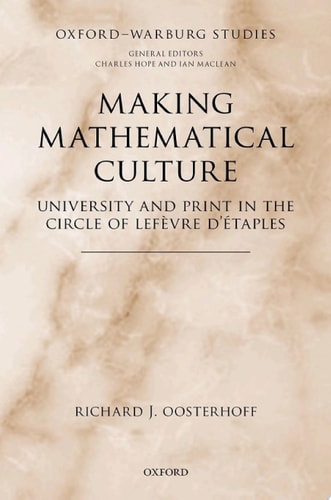
Making Mathematical Culture: University and Print in the Circle of Lefèvre d'Étaples
0
0
As an Amazon Associate and affiliate partner, Menrva Books earns from qualifying purchases. Learn more
Author Description
In 1503, for the first time, a student in Paris was able to spend his entire university career studying only the printed textbooks of his teacher, thanks to the works of the humanist and university reformer Jacques Lefèvre d'Étaples (c. 1455-1536). As printed books became central to the intellectual habits of following generations, Lefèvre turned especially to mathematics as a way to renovate the medieval university. Making Mathematical Culture argues this was a pivatol moment in the cultural history of Europe and explores how the rise of the printed book contributed to the growing profile of mathematics in the region. Using student manuscripts and annotated books, Making Mathematical Culture offers a new account of printed textbooks, as jointly made by masters and students, and how such collaborative practices informed approaches to mathematics.
Menrva's Summary
THE THESIS
This book investigates how the emergence of printed textbooks in the early sixteenth century facilitated a shift in the pedagogical and intellectual status of mathematics within the European university system. Richard J. Oosterhoff, a scholar of early modern intellectual history, examines the work of Jacques Lefèvre d'Étaples to argue that the transition from manuscript to print was not merely a technological change but a collaborative process that redefined the relationship between masters, students, and mathematical knowledge. By analyzing the material culture of the classroom, the author demonstrates how these printed texts served as tools for institutional reform and the broader renovation of medieval academic traditions.
THE SCOPE MAP
What You Will Find
- Analysis of the pedagogical influence of Jacques Lefèvre d'Étaples in early 16th-century Paris.
- Examination of the transition from handwritten lecture notes to standardized printed mathematical textbooks.
- Case studies involving student-annotated books and surviving manuscript records.
- Exploration of the collaborative nature of textbook production between university masters and their pupils.
Scope Limits
- The study focuses primarily on the Parisian university context and the specific circle of Lefèvre d'Étaples.
- It does not provide a comprehensive survey of all mathematical developments across Europe during the entire Renaissance period.
THE AUTHORITY PERSPECTIVE
Scholars in the history of science and print culture identify this work as a significant contribution to understanding the material conditions of early modern learning. Readers frequently note the academic density of the prose and the author's meticulous use of primary source marginalia to reconstruct classroom practices.
Page Count:
290
Publication Date:
2018-01-01
Publisher:
OUP Oxford
ISBN-10:
0192556568
ISBN-13:
9780192556561
History
Print Culture
Special Topics
Mathematics
Education - History
Intellectual History
Community Tags
Similar Books