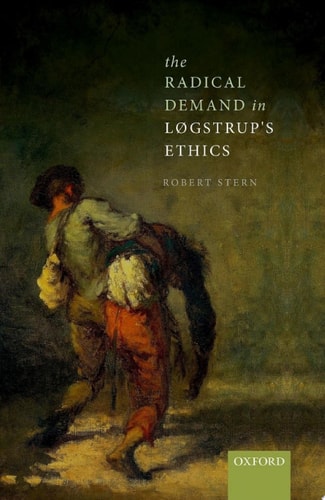
The Radical Demand in Løgstrup's Ethics
0
0
As an Amazon Associate and affiliate partner, Menrva Books earns from qualifying purchases. Learn more
Author Description
How much does ethics demand of us? On what authority does it demand it? How does what ethics demand relate to other requirements, such as those of prudence, law, and social convention? Does ethics really demand anything at all? Questions of this sort lie at the heart of the work of the Danish philosopher and theologian K. E. Løgstrup (1905-1981), and in particular his key text The Ethical Demand (1956). In The Radical Demand in Løgstrup's Ethics, Robert Stern offers a full account of that text, and situates Løgstrup's distinctive position in relation to Kant, Kierkegaard, Levinas, Darwall and Luther. For Løgstrup, the ethical situation is primarily one in which the fate of the other person is placed in your hands, where it is then your responsibility to do what is best for them. The demand therefore does not come from the other person as such, as what they ask you to do may be different from what you should do. It is also not laid down by social rules, nor by God or by any formal principle of practical reason, such as Kant's principle of universalizability. Rather, it comes from what is required to care for the other, and the directive power of their needs in the situation. Løgstrup therefore rejects accounts of ethical obligation based on the commands of God, or on abstract principles governing practical reason, or on social norms; instead he develops a different picture, at the basis of which is our interdependence, which he argues gives his ethics a grounding in the nature of life itself.
Menrva's Summary
THE THESIS
This book investigates the nature and source of ethical obligation as articulated in K. E. Løgstrup's seminal work, The Ethical Demand. Robert Stern, a scholar of moral philosophy, provides a comprehensive analysis of Løgstrup's framework, which posits that ethical responsibility arises from the inherent interdependence of human life rather than from divine command, social convention, or abstract rational principles. Stern evaluates this position by contrasting it with the ethical theories of Kant, Kierkegaard, Levinas, Darwall, and Luther to clarify the unique mechanics of Løgstrup's moral philosophy.
THE SCOPE MAP
What You Will Find
- A detailed examination of K. E. Løgstrup's 1956 text, The Ethical Demand.
- A comparative analysis of Løgstrup's ethics against major historical and contemporary moral frameworks.
- An exploration of the concept of the 'radical demand' as a response to the needs of others in specific situations.
Scope Limits
- The text focuses primarily on Løgstrup's specific ethical theory and does not provide a general survey of all 20th-century Danish philosophy.
- It does not attempt to reconcile Løgstrup's views with every modern secular ethical system.
THE AUTHORITY PERSPECTIVE
Scholars and students of moral philosophy recognize this work as a rigorous and necessary resource for understanding Løgstrup's contribution to ethics. Readers frequently note the academic density of the prose, which serves as a specialized study for those already familiar with the history of moral thought.
Page Count:
386
Publication Date:
2018-01-01
Publisher:
OUP Oxford
ISBN-10:
0192564242
ISBN-13:
9780192564245
Philosophy
Moral Philosophy
Ethics
Theology
Danish Philosophy