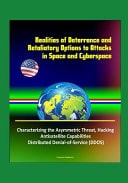
Realities of Deterrence and Retaliatory Options to Attacks in Space and Cyberspace: Characterizing the Asymmetric Threat, Hacking, Antisatellite Capabilities, Distributed Denial-Of-Service (DDOS)
0
0
As an Amazon Associate and affiliate partner, Menrva Books earns from qualifying purchases. Learn more
Author Description
Tthis unique book discusses the realities of deterrence and retaliatory options to attacks in space and cyberspace. Since the last years of the 20th Century, threats in space and cyberspace have become prominent, to the point where an attack can threaten state sovereignty and have regional, if not global consequences. These threats are emerging at the same time that the United States' reliance on its own space and cyber capabilities increases to maintain international diplomatic leadership and conventional military superiority. US national policy speaks to deterring and defending against such attacks, but a lack of international precedent and the legal limitations of war, specifically attribution, proportionality and discrimination, limit United States response options to an unprovoked attack in these domains. In order to establish an effective deterrence, the United States must move away from the Cold War model and fashion a global environment that fosters effective deterrent strategies. Building this new order requires the United States lead the international debate to define attacks in space and cyberspace and appropriate "self-defense" responses under Article 51 of the United Nations Charter. The United States must demonstrate the political will to take action unilaterally, if necessary, to set precedent, and erase the failures of past transgressions, including NATO's failure to respond to the Estonia cyber attacks in 2007. As deterrence is predicated on the ability to attribute in order to hold an adversary at risk, the United States must improve its ability to detect and attribute attacks in space and cyberspace. Finally, the United States must reduce its space and cyberspace vulnerabilities and prove to any potential adversary that its military can successfully fight through any degradation and win. Unless the United States takes prominent actions on these fronts and establishes an international recognized lexicon on space and cyberspace, any deterrent postur
Menrva's Summary
THE THESIS
This book examines the challenges of deterring and responding to attacks in space and cyberspace, particularly in light of asymmetric threats and the increasing reliance of the United States on these domains. The text addresses the limitations imposed by international law and the difficulty of attribution, arguing for a shift away from Cold War deterrence models. It posits that the United States must lead international efforts to define attacks and appropriate responses, potentially acting unilaterally to set precedents and improve its capacity to detect and attribute threats. Ultimately, the book contends that reducing vulnerabilities and demonstrating the ability to fight through degradation are crucial for effective deterrence.
THE SCOPE MAP
- Analysis of asymmetric threats in space and cyberspace, including hacking and antisatellite capabilities.
- Discussion of retaliatory options and the legal limitations of warfare in these domains.
- Examination of the challenges of attribution, proportionality, and discrimination in response to attacks.
- Critique of Cold War deterrence models and the need for new strategies.
- The role of the United States in defining international norms and self-defense responses under Article 51 of the UN Charter.
- Emphasis on the need for political will to act unilaterally and set international precedent.
- Strategies for improving the detection and attribution of space and cyber attacks.
- The importance of reducing U.S. vulnerabilities and ensuring military resilience in degraded environments.
THE AUTHORITY PERSPECTIVE
The book, authored by U.S. government entities including the Department of Defense and Air Force, presents a strategic analysis of deterrence in space and cyberspace. It highlights the evolving threat landscape and the complexities of international law in responding to attacks. The text advocates for proactive U.S. leadership in establishing international norms and improving attribution capabilities to bolster deterrence. The inferred perspective is that this work serves as a policy-oriented examination for defense and national security professionals.
Page Count:
69
Publication Date:
2017-04-26
Publisher:
Amazon Digital Services LLC - KDP Print US
ISBN-10:
1521158932
ISBN-13:
9781521158937
Non-Fiction
Science & Technology
Politics
Military Strategy
Cybersecurity
National security
International relations
Space Policy
Community Tags
Similar Books





Reader Comments
Share Your Thoughts
No comments yet. Be the first to share your thoughts!