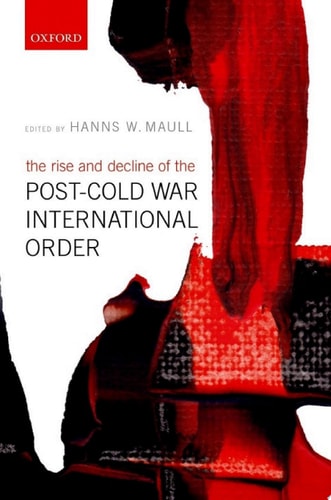
The Rise and Decline of the Post-Cold War International Order
0
0
As an Amazon Associate and affiliate partner, Menrva Books earns from qualifying purchases. Learn more
Author Description
This books surveys the evolution of the international order in the quarter century since the end of the Cold War through the prism of developments in key regional and functional parts of the 'liberal international order 2.0' (LIO 2.0) and the roles played by two key ordering powers, the United States and the People's Republic of China. Among the partial orders analysed in the individual chapters are the regions of Europe, the Middle East and East Asia and the international regimes dealing with international trade, climate change, nuclear weapons, cyber space, and international public health emergencies, such as SARS and ZIKA. To assess developments in these various segments of the LIO 2.0, and to relate them to developments in the two other crucial levels of political order, order within nation-states, and at the global level, the volume develops a comprehensive, integrated framework of analysis that allows systematic comparison of developments across boundaries between segments and different levels of the international order. Using this framework, the book presents a holistic assessment of the trajectory of the international order over the last decades, the rise, decline, and demise of the LIO 2.0, and causes of the dangerous erosion of international order over the last decade.
Menrva's Summary
THE THESIS
This book investigates the trajectory of the 'liberal international order 2.0' (LIO 2.0) to determine the causes behind its recent erosion and potential demise. Hanns W. Maull, a scholar of international relations, utilizes a comprehensive, integrated framework to analyze how regional and functional shifts have impacted global stability. By examining the roles of the United States and China alongside domestic and global political developments, the author provides a systematic assessment of the post-Cold War era.
THE SCOPE MAP
What You Will Find
- Analysis of regional orders in Europe, the Middle East, and East Asia.
- Evaluation of functional regimes including international trade, climate change, nuclear non-proliferation, cyber space, and public health.
- A comparative framework for assessing political order across nation-state and global levels.
Scope Limits
- The text focuses primarily on the period from the end of the Cold War to the present decade.
- It does not provide an exhaustive history of all international organizations, focusing instead on the LIO 2.0 framework.
THE AUTHORITY PERSPECTIVE
Experts recognize this work as a structured analytical tool for understanding the complexities of contemporary global governance. Readers frequently note the academic density of the prose, which is well-suited for students and practitioners of international relations.
Page Count:
366
Publication Date:
2018-01-01
Publisher:
OUP Oxford
ISBN-10:
0192564188
ISBN-13:
9780192564184
History
International relations
Global Studies
Geopolitics