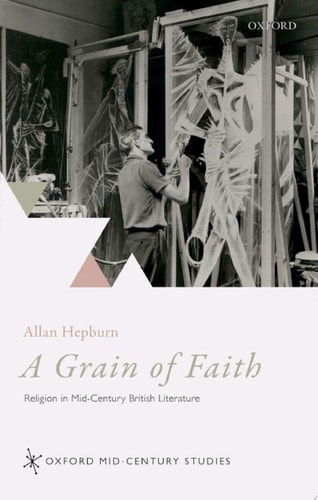
A Grain of Faith: Religion in Mid-Century British Literature
0
0
As an Amazon Associate and affiliate partner, Menrva Books earns from qualifying purchases. Learn more
Author Description
During and after the Second World War, there was a concerted thinking about religion in Britain. Not only were leading international thinkers of the day theologians—Ronald Niebuhr, Paul Tillich, Jacques Maritain—but leading writers contributed to discussions about religion. Graham Greene, Muriel Spark, and Barbara Pym incorporated miracles, evil, and church-going into their novels, while Louis MacNeice, T. S. Eliot, and C. S. Lewis gave radio broadcasts about the role of Christianity in contemporary society. Certainly the war revived interest in aspects of Christian life. Salvation and redemption were on many people's minds. The Ministry of Information used images of bombed churches to stoke patriotic fervour, and King George VI led a series of Days of National Prayer that coincided with crucial events in the Allied campaign. After the war and throughout the 1950s, approximately 1.4 million Britons converted to Roman Catholicism as a way of expressing their spiritual ambitions and solidarity with humanity on a world-wide scale. Religion provided one way for writers to answer the question, 'what is man?' It also afforded ways to think about social obligation and ethical engagement. Moreover, the mid-century turn to religion offered ways to articulate statehood, not from the perspective of nationhood and politics, but from the perspective of moral action and social improvement. Instead of being a retreat into seclusion and solitude, the mid-century turn to religion is a call to responsibility.
Menrva's Summary
THE THESIS
This book investigates how religion functioned as a primary intellectual and ethical framework for British writers navigating the social and moral crises of the mid-twentieth century. Allan Hepburn, a scholar of twentieth-century literature, examines the intersection of theological discourse and creative writing during and after the Second World War. By analyzing the works of novelists, poets, and public intellectuals, he argues that the mid-century turn to religion was not an act of withdrawal, but a deliberate method for articulating social responsibility and moral engagement in a post-war landscape.
THE SCOPE MAP
What You Will Find
- Analysis of religious themes in the works of Graham Greene, Muriel Spark, and Barbara Pym
- Examination of radio broadcasts and public discourse by T. S. Eliot, C. S. Lewis, and Louis MacNeice
- Historical context regarding the rise of Roman Catholicism in 1950s Britain
- Exploration of the relationship between statehood, moral action, and Christian ethics
Scope Limits
- The text focuses primarily on Christian perspectives and does not provide an exhaustive survey of non-Christian religious movements in the period
- The analysis is limited to the British cultural and literary context
THE AUTHORITY PERSPECTIVE
Scholars recognize this work as a significant contribution to the study of mid-century British intellectual history. Readers frequently note the academic density of the prose and the author's ability to synthesize theological debates with literary analysis.
Page Count:
277
Publication Date:
2018-01-01
Publisher:
OUP Oxford
ISBN-10:
0192563653
ISBN-13:
9780192563651
History
Indigenous
British literature
Cultural History
Literary Criticism
English literature
Religion and literature
Mid-Century Studies
Community Tags
Similar Books