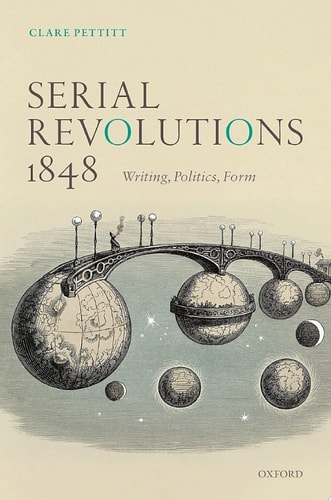
Serial Revolutions 1848: Writing, Politics, Form
0
0
As an Amazon Associate and affiliate partner, Menrva Books earns from qualifying purchases. Learn more
Author Description
1848 was a pivotal moment not only in Europe but in much of the rest of the world too. Marx's scornful dismissal of the revolutions created a historiography for 1848 that has persisted for more than 150 years. Serial Revolutions 1848 shows how, far from being the failure that Karl Marx claimed them to be, the revolutions of 1848 were a powerful response to the political failure of governments across Europe to care for their people. Crucially, this revolutionary response was the result of new forms of representation and mediation: until the ragged and the angry could see themselves represented, and represented as a serial phenomenon, such a political consciousness was impossible. By the 1840s, the developments in printing, transport, and distribution discussed in Clare Pettitt's Serial Forms: The Unfinished Project of Modernity, 1815-1848 (Oxford University Press, 2020) had made the social visible in an unprecedented way. This print revolution led to a series of real and bloody revolutions in the streets of European cities. The revolutionaries of 1848 had the temerity to imagine universal human rights and a world in which everyone could live without fear, hunger, or humiliation. If looked at like this, the events of 1848 do not seem such 'poor incidents', as Marx described them, nor such an embarrassing failure after all. Returning to 1848, we can choose to look back on that 'springtime of the peoples' as a moment of tragi-comic failure, obliterated by the brutalities that followed, or we can look again, and see it as a proleptic moment of stored potential, an extraordinary series of events that generated long-distance and sustainable ideas about global citizenship, international co-operation, and a shared and common humanity which have not yet been fully understood or realised.
Menrva's Summary
THE THESIS
This book investigates whether the revolutions of 1848 were truly the failures described by Karl Marx or if they represented a significant, overlooked development in political consciousness and global human rights. Clare Pettitt, an academic specializing in 19th-century literature and culture, challenges the long-standing historiographical consensus by examining how advancements in print media, transport, and distribution enabled the public to visualize themselves as a collective political force. She argues that these revolutions were not merely chaotic outbursts but a sophisticated, mediated response to government failure that established the foundations for modern global citizenship.
THE SCOPE MAP
What You Will Find
- Analysis of the intersection between 19th-century print culture and political mobilization.
- A re-evaluation of the 'springtime of the peoples' as a source of sustainable political ideas.
- Examination of the role of mediation and representation in forming revolutionary consciousness.
Scope Limits
- The text focuses primarily on the European context of 1848 rather than a comprehensive global history of all concurrent uprisings.
- It does not provide a minute-by-minute military account of the street battles, focusing instead on the cultural and political implications of the events.
THE AUTHORITY PERSPECTIVE
Scholars and historians recognize this work as a significant intervention in 19th-century studies, particularly for its focus on the relationship between media forms and political action. Readers frequently note the academic density of the prose, which requires a foundational understanding of both European history and media theory to fully appreciate the author's arguments.
Page Count:
476
Publication Date:
2022-01-01
Publisher:
OUP Oxford
ISBN-10:
0192566156
ISBN-13:
9780192566157
History
19th Century
Media Studies
Revolutions
English literature
Historiography
Indigenous
European History
Community Tags
Similar Books