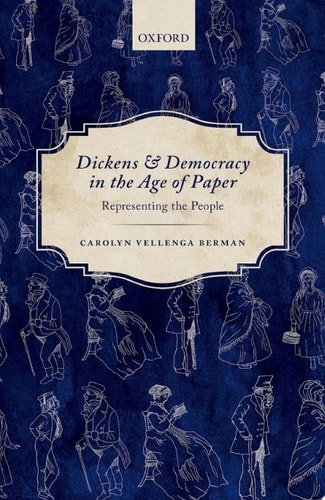
Dickens and Democracy in the Age of Paper: Representing the People
0
0
As an Amazon Associate and affiliate partner, Menrva Books earns from qualifying purchases. Learn more
Author Description
This book examines Charles Dickens's fiction alongside publications emanating from Parliament. It argues that Dickens and Parliament were engaged in competitive efforts to represent the People at a crucial moment in the history of representative democracy--when the British government was under enormous political pressure to expand the franchise beyond a narrow band of male landowners. Contending that fiction and the literature of Parliament interacted at a host of levels--jostling one another in the same bookshops--it reads Dickens's novels in tandem with blue books, the practice texts of shorthand manuals, and Dickens's journalism. It shows how his fiction mocks parliamentary form (as in Pickwick Papers), canvasses the history of parliamentary representation (as in Bleak House), and depicts the relation of the People to the state as well as commerce (as in Little Dorrit). It thus rethinks the history of the Victorian novel by examining its rivalry with Parliament in the expanding world of print publication.
Menrva's Summary
THE THESIS
This book investigates the competitive relationship between Charles Dickens's fiction and the parliamentary literature of the Victorian era to determine how both institutions sought to represent the British public. Carolyn Vellenga Berman utilizes her expertise in Victorian studies to analyze the intersection of literary production and political discourse during a period of significant franchise expansion. By examining the rivalry between the novel and government publications, the author argues that Dickens's work functioned as a critical counter-narrative to the formal structures of the state.
THE SCOPE MAP
What You Will Find
- Comparative analysis of Dickens's novels alongside parliamentary blue books and shorthand manuals.
- Examination of the political context surrounding the expansion of the British franchise.
- Case studies of specific texts including Pickwick Papers, Bleak House, and Little Dorrit.
- Analysis of the role of print culture and bookshops in shaping public political discourse.
Scope Limits
- The study focuses primarily on the Victorian period and does not extend to modern democratic theory.
- The analysis is limited to the interaction between Dickens's specific literary output and parliamentary documents rather than a comprehensive history of all Victorian political literature.
THE AUTHORITY PERSPECTIVE
Scholars in the field of Victorian studies recognize this work as a significant contribution to understanding the intersection of literature and political representation. Readers frequently note the academic density of the prose and the depth of the archival research presented by the author.
Page Count:
360
Publication Date:
2022-01-01
Publisher:
OUP Oxford
ISBN-10:
0192659936
ISBN-13:
9780192659934
History
Victorian
Print Culture
19th Century
Political History
Indigenous
English literature
Democracy history
Literary Criticism
Community Tags
Similar Books