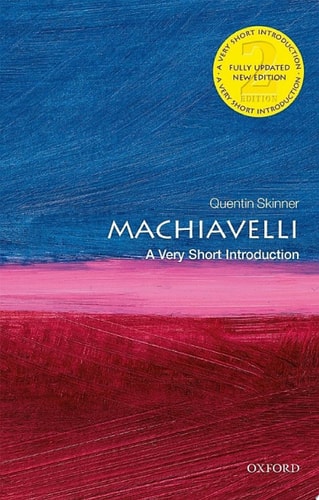
Machiavelli: A Very Short Introduction
0
0
As an Amazon Associate and affiliate partner, Menrva Books earns from qualifying purchases. Learn more
Author Description
Niccolò Machiavelli taught that political leaders must be prepared to do evil so that good may come of it, and his name has been a byword ever since for duplicity and immorality. Is his sinister reputation deserved? In answering this question Quentin Skinner traces the course of Machiavelli's adult life, from his time as Second Chancellor of the Florentine republic, during which he met with kings, the pope, and the Holy Roman Emperor; to the fall of the republic in 1512; to his death in 1527. It was after the fall of the Republic that Machiavelli composed his main political works: The Prince, the Discourses, and The History of Florence. In this second edition of his Very Short Introduction Skinner includes new material on The Prince, showing how Machiavelli developed his neo-classical political theory, through engaging in continual dialogue with the ancient Roman moralists and historians, especially Cicero and Livy. The aim of political leaders, Machiavelli argues, should be to act virtuously so far as possible, but to stand ready 'to be not good' when this course of action is dictated by necessity. Exploring the pivotal concept of princely virtù to be found in classical and Renaissance humanist texts, Skinner brings new light to Machiavelli's philosophy of a willingness to do whatever may be necessary - whether moral or otherwise -to maintain a position of power. ABOUT THE SERIES: The Very Short Introductions series from Oxford University Press contains hundreds of titles in almost every subject area. These pocket-sized books are the perfect way to get ahead in a new subject quickly. Our expert authors combine facts, analysis, perspective, new ideas, and enthusiasm to make interesting and challenging topics highly readable.
Menrva's Summary
THE THESIS
This book investigates whether Niccolò Machiavelli’s reputation for duplicity and immorality is historically justified or a misinterpretation of his political theory. Quentin Skinner, a renowned scholar of political thought, utilizes biographical data and textual analysis of Machiavelli’s major works to re-examine the Florentine thinker's motivations. By situating Machiavelli within the context of Renaissance humanism and his interactions with contemporary power structures, Skinner argues that Machiavelli’s philosophy was a calculated response to the necessity of maintaining state stability rather than a simple endorsement of evil.
THE SCOPE MAP
What You Will Find
- A biographical overview of Machiavelli’s life from his time as Second Chancellor of the Florentine republic to his death in 1527.
- Analysis of key texts including The Prince, the Discourses, and The History of Florence.
- Examination of the concept of 'virtù' in relation to classical Roman moralists like Cicero and Livy.
Scope Limits
- The text does not provide an exhaustive history of the Italian Renaissance beyond its direct impact on Machiavelli’s political development.
- It does not offer a comprehensive critique of all subsequent Machiavellian scholarship.
THE AUTHORITY PERSPECTIVE
Experts and academics frequently cite this work as a concise and authoritative entry point for understanding the nuances of Machiavellian thought. Readers often note that the prose is accessible yet maintains a high level of intellectual rigor suitable for both students and general readers.
Page Count:
144
Publication Date:
2019-01-01
Publisher:
OUP Oxford
ISBN-10:
0192574558
ISBN-13:
9780192574558
History
Philosophy
Biography
Political Philosophy
Individual Philosophers
Politics & Government
Community Tags
Other Editions(3)
Similar Books







Reader Comments
Share Your Thoughts
No comments yet. Be the first to share your thoughts!