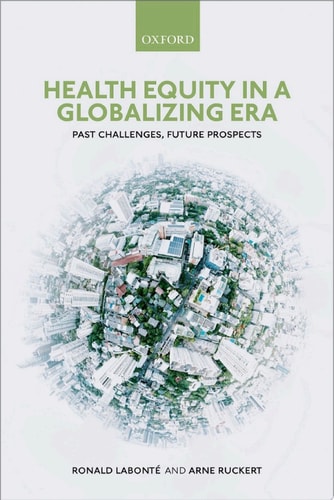
Health Equity in a Globalizing Era: Past Challenges, Future Prospects
0
0
As an Amazon Associate and affiliate partner, Menrva Books earns from qualifying purchases. Learn more
Author Description
Why do some countries and populations suffer from poverty and ill health, whilst others are more prosperous and healthy? What are the inherently global (trans-border) issues that affect inequities in disease burden and health opportunities for individuals and nations? Traditionally, the focus of global health has been 'international health': the concern for high burdens of disease in generally low-income countries. To answer these questions however, we need to modernise our understanding of globalization as a phenomenon. Health Equity in a Globalizing Era: Past Challenges, Future Prospects examines how globalization processes since the on-set of neoliberalism affect equity in global health outcomes, and emphasises access to important social determinants of health. With a basis in political economy, the book covers key globalization concepts and theory, and presents a thorough background to the field. Case studies, illustrations, and new research all combine to make this title a comprehensive and current discussion of the various pathways that connect globalization to health equity outcomes. It looks at changes in migration, labour markets, trade and investment rules, international development assistance, health systems, infectious and non-communicable disease risks, environmental health, and gendered aspects of globalization's health dialectic. In addition, it argues for a reform of the global governance structure, the significant role of human rights, and the importance of a strong civil society in achieving greater social justice in health. Ideal for senior undergraduate and graduate students in global health programs, global health scholars and practitioners in government policy and health/development NGOs, Health Equity in a Globalizing Era: Past Challenges, Future Prospects is a significant contribution to our new understanding of globalization and global public health.
Menrva's Summary
THE THESIS
This book investigates the complex causal relationships between globalization processes and the persistent inequities in health outcomes across different nations and populations. Arne Ruckert and Ronald Labonté, both established scholars in global health and political economy, utilize a political economy framework to analyze how neoliberal policies have shaped the social determinants of health. They argue that current global governance structures are insufficient and propose a reform-oriented approach centered on human rights and civil society engagement to mitigate health disparities.
THE SCOPE MAP
What You Will Find
- Analysis of the impact of trade, investment rules, and labor markets on health equity.
- Examination of migration patterns and their influence on global disease burdens.
- Discussion of the intersection between environmental health, gender, and globalization.
- Proposals for restructuring global governance to prioritize social justice.
Scope Limits
- The text focuses primarily on the neoliberal era and may not provide extensive historical analysis of pre-20th-century health systems.
- It emphasizes structural and systemic factors over individual clinical or biological interventions.
THE AUTHORITY PERSPECTIVE
Experts and academics in the field of global health recognize this work as a comprehensive resource for understanding the structural drivers of health inequality. Readers frequently note the academic density of the prose, making it particularly suitable for graduate-level study and policy research.
Page Count:
461
Publication Date:
2019-01-01
Publisher:
OUP Oxford
ISBN-10:
0192572253
ISBN-13:
9780192572257
Health Policy
Medical
Public Health
Globalization
International Development
Allied Health
Social justice
Community Tags
Other Editions(2)

Similar Books











Reader Comments
Share Your Thoughts
No comments yet. Be the first to share your thoughts!