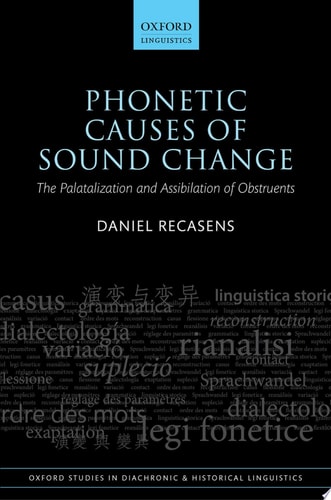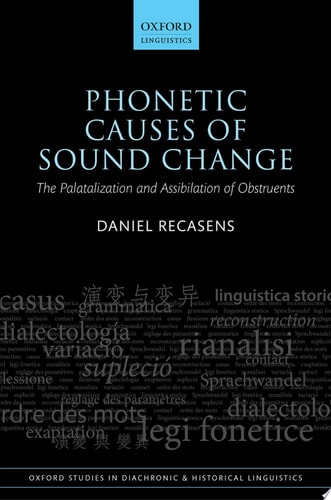
Phonetic Causes of Sound Change: The Palatalization and Assibilation of Obstruents
0
0
As an Amazon Associate and affiliate partner, Menrva Books earns from qualifying purchases. Learn more
Author Description
This book provides an integrated account of the phonetic causes of the diachronic processes of palatalization and assibilation of velar and labial stops and labiodental fricatives, as well as the palatalization and affrication of dentoalveolar stops. While previous studies have been concerned with the typology of sound inventories and of the processes of palatalization and assibilation, this volume not only deals with the typological patterns but also outlines the articulatory and acoustic causes of these sound changes. In his articulation-based account, Daniel Recasens argues that the affricate and fricative outcomes of these changes developed via an intermediate stage, namely an (alveolo)palatal stop with varying degrees of closure fronting. Particular emphasis is placed on the one-to-many relationship between the input and output consonant realizations, on the acoustic cues that contribute to the implementation of these sound changes, and on the contextual, positional, and prosodic conditions that most favour their development. The analysis is based on extensive data from a wide range of language families, including Romance, Bantu, Slavic, and Germanic, and draws on a variety of sources, such as linguistic atlases, articulatory and acoustic studies, and phoneme identification tests.
Menrva's Summary
THE THESIS
This book investigates the phonetic mechanisms and articulatory causes driving the diachronic processes of palatalization and assibilation in various consonant classes. Daniel Recasens, a specialist in articulatory and acoustic phonetics, synthesizes cross-linguistic data to argue that these sound changes typically proceed through an intermediate (alveolo)palatal stop stage. By examining the acoustic cues and contextual conditions that facilitate these shifts, the author provides a comprehensive framework for understanding how consonant realizations evolve over time.
THE SCOPE MAP
What You Will Find
- Analysis of velar, labial, and dentoalveolar stop evolution
- Examination of acoustic cues and closure fronting mechanisms
- Comparative data from Romance, Bantu, Slavic, and Germanic language families
- Integration of linguistic atlases and phoneme identification testing
Scope Limits
- Does not provide a general introduction to historical linguistics for non-specialists
- Focuses primarily on obstruents rather than sonorant sound changes
THE AUTHORITY PERSPECTIVE
Experts in the field recognize this work as a rigorous, data-driven contribution to the study of sound change. Readers frequently note the high level of technical density, making it a specialized resource for phoneticians and historical linguists.
Page Count:
240
Publication Date:
2020-01-01
Publisher:
OUP Oxford
ISBN-10:
0192583638
ISBN-13:
9780192583635
Diachronic Linguistics
Phonetics
English
Historical linguistics
English & College Success
Linguistics
Phonology