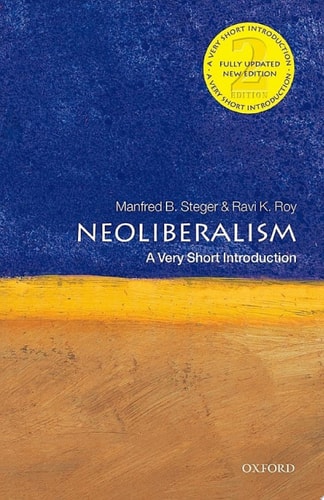
Neoliberalism: A Very Short Introduction
0
0
As an Amazon Associate and affiliate partner, Menrva Books earns from qualifying purchases. Learn more
Author Description
Very Short Introductions: Brilliant, Sharp, Inspiring Anchored in the principles of free-market economics, neoliberalism emerged in the 1990s as the world's most dominant economic paradigm. It has been associated with various political leaders from Ronald Reagan, Margaret Thatcher, and Bill Clinton, to Tony Blair, Barack Obama, and Manmohan Singh. Neoliberalism even penetrated deeply into communist China's powerful economic system. However, the 2008 Global Financial Crisis and the related European Sovereign Debt Crisis triggered a decade of economic volatility and insecurity that boosted the fortunes of the 1 per cent while saddling the 99 per cent with stagnant wages and precarious work. As a result of this Great Recession, neoliberalism fortunes have waned considerably. This downward trend further accelerated with the recent surge of national populism around the world that brought to power outspoken critics of neoliberalism like Donald Trump, Boris Johnson, Jair Bolsonaro, and Narendra Modi. Is neoliberalism doomed or will it regain its former glory? And what are the major types of neoliberalism, and how did they evolve over the decades? Responding to these crucial questions, this Very Short introduction explores the considerable variations of neoliberalism around the world, and discusses the origins, evolution, and core ideas of neoliberalism. This new edition brings the story of neoliberalism up to date, and asks whether new versions of neoliberalism might succeed in drowning out the rising tide of national populism and its nostalgic longing for a return to territorial sovereignty and national greatness. ABOUT THE SERIES: The Very Short Introductions series from Oxford University Press contains hundreds of titles in almost every subject area. These pocket-sized books are the perfect way to get ahead in a new subject quickly. Our expert authors combine facts, analysis, perspective, new ideas, and enthusiasm to make interesting and challenging topics highly readable.
Menrva's Summary
THE THESIS
This book investigates the origins, evolution, and current status of neoliberalism as a dominant economic and political paradigm. Authors Manfred B. Steger and Ravi K. Roy, both established scholars in global studies and public policy, utilize historical analysis and economic data to trace the rise of free-market principles from the late 20th century to the present. They argue that while neoliberalism reshaped global systems, its recent decline is tied to the 2008 financial crisis and the subsequent rise of national populism.
THE SCOPE MAP
What You Will Find
- Historical overview of neoliberalism from the 1990s to the present
- Comparative analysis of neoliberal variations across different global regions
- Examination of the impact of the 2008 Global Financial Crisis and European Sovereign Debt Crisis
- Discussion on the intersection of neoliberalism and national populism
Scope Limits
- Does not provide an exhaustive technical manual for economic modeling
- Focuses primarily on the political and ideological dimensions rather than purely mathematical economic theory
THE AUTHORITY PERSPECTIVE
Experts and readers frequently note that this text provides a concise, accessible entry point into a complex ideological subject. It is widely regarded as a reliable foundational resource for students and general readers seeking to understand the historical trajectory of global economic policy.
Page Count:
176
Publication Date:
2021-01-01
Publisher:
OUP Oxford
ISBN-10:
0192589555
ISBN-13:
9780192589552
History
Economics
Non-Fiction
Globalization
Community Tags
Other Editions(3)

Similar Books










Reader Comments
Share Your Thoughts
No comments yet. Be the first to share your thoughts!