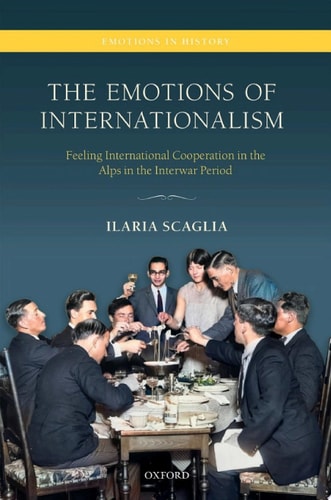
The Emotions of Internationalism: Feeling International Cooperation in the Alps in the Interwar Period
0
0
As an Amazon Associate and affiliate partner, Menrva Books earns from qualifying purchases. Learn more
Author Description
The Emotions of Internationalism follows a number of international people and institutions active in the Alps in the 1920s and 1930s, exploring how they understood emotions and how they tried to employ them to achieve their political and non-political goals. Through the analysis of a broad spectrum of unpublished archival materials in four languages (English, French, Italian, and German), this study takes readers on an evocative, historical journey through the Alps. A wide range of characters populate its pages, from Heidi and the protagonists of novels and films set on the mountains, to Woodrow Wilson and other high-level political figures active both inside and outside of the League of Nations, to the alpinists and climbers engaged in hikes and international congresses, to the many children involved in camping trips, to the countless patients of the sanatoria for the treatment of tuberculosis which for decades used to dot alpine villages and to excite the popular imagination. At the centre of the volume are people's emotions-real and imagined-from the resentment left after the First World War to the 'friendship' evoked in speeches and concretely implemented in a number of alpine settings for a variety of purposes, to the 'joy' that contemporaries saw as the key to navigating the complexities of 'modernity' and to avoiding another war. The result is a compelling overview of the institutions and people involved in international cooperation in the 1920s and 1930s, understood through the lens of the history of emotions.
Menrva's Summary
THE THESIS
This study investigates how international actors in the interwar period utilized and understood emotions as a mechanism for fostering cooperation and navigating the political complexities of the 1920s and 1930s. Dr. Ilaria Scaglia, a historian specializing in the history of emotions and internationalism, utilizes a diverse array of archival materials to construct her argument. By examining the intersection of personal sentiment and institutional diplomacy, she posits that emotional management was a deliberate strategy employed to mitigate the trauma of the First World War and prevent future conflict. The work synthesizes political history with cultural analysis to demonstrate how feelings were mobilized within the specific geographical and social context of the Alps.
THE SCOPE MAP
What You Will Find
- Analysis of archival documents in English, French, Italian, and German.
- Examination of diverse social groups including politicians, alpinists, patients, and children.
- Case studies of institutions like the League of Nations and alpine sanatoria.
- Theoretical framework applying the history of emotions to international cooperation.
Scope Limits
- The study is geographically focused on the Alpine region during the interwar period.
- It does not provide a comprehensive history of the League of Nations outside of its emotional and alpine-related activities.
THE AUTHORITY PERSPECTIVE
Scholars in the field of modern European history recognize this work for its innovative application of emotional history to the study of international relations. Experts frequently highlight the depth of the multilingual archival research as a significant contribution to understanding the cultural underpinnings of interwar diplomacy.
Page Count:
250
Publication Date:
2019-01-01
Publisher:
OUP Oxford
ISBN-10:
0192587722
ISBN-13:
9780192587725
History
Europe
History of Emotions
Modern History
European History
International relations
Educational Resources
Cultural History
Community Tags
Similar Books