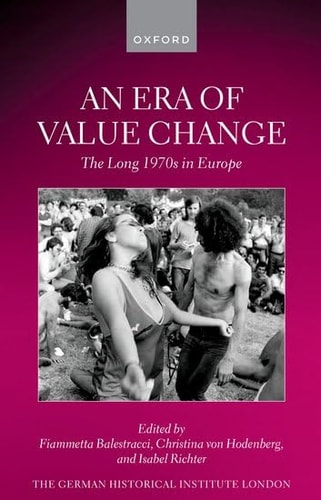
An Era of Value Change: The Long 1970s in Europe
0
0
As an Amazon Associate and affiliate partner, Menrva Books earns from qualifying purchases. Learn more
Author Description
The long 1970s have recently emerged as the start of a new epoch in which we still live. This volume asks whether the accelerated value change of these years can be explained with the rise of a new kind of post-rationalism, and presents case studies from across highly industrialized Europe. Theories of value change are tested historically in France, Italy, the two Germanies, the Soviet Union, Poland, Sweden, Spain, Greece, and Portugal. Approaching the era from long-term perspective, the chapters trace the rise of post-rational values in different fields such as social science debates, gender roles, sexuality, mass media, religiosity, humanitarianism, tourism, and nonconformist consumerism. The essays engage in controversy on whether new norms and practices that developed during the decade find their origin in post-rational values, a rise in affluence and education, or political changes.The comparison in this volume extends both geographically, across the Iron Curtain and including 'smaller' countries, and chronologically, placing the 1970s as a key decade of transformation into a continuum spanning the long twentieth century. The authors show from different perspectives how the transformations of the long 1970s were linked to the legacy of the two world wars, as well as how they were related to the 1960s, which have often been presented as the primary decade of change. Instead of focusing on the dichotomy of materialism and post-materialism advocated by Ronald Inglehart's much-discussed theory of value change, the volume considers the 1970s move towards post-rational values against the backdrop of contemporary intellectual debates on rationalism in advanced industrialized societies.
Menrva's Summary
THE THESIS
This volume investigates whether the accelerated value shifts observed during the long 1970s in Europe can be attributed to the emergence of a new form of post-rationalism. The editors and contributors, representing a collaborative effort from the German Historical Institute, utilize a comparative historical framework to test existing theories of value change. By analyzing diverse national contexts, the authors argue that the transformations of this decade are deeply rooted in the legacy of the twentieth century rather than existing solely as a reaction to the 1960s.
THE SCOPE MAP
What You Will Find
- Comparative case studies covering France, Italy, Germany, the Soviet Union, Poland, Sweden, Spain, Greece, and Portugal.
- Analysis of social science debates, gender roles, sexuality, mass media, religiosity, and consumerism.
- Historical testing of Ronald Inglehart’s materialism versus post-materialism theory.
- Examination of the transition from the post-war era into contemporary industrialized society.
THE AUTHORITY PERSPECTIVE
Experts identify this volume as a significant contribution to the historiography of the late twentieth century, particularly for its cross-border approach to cultural shifts. Readers frequently note the academic density of the prose, which serves as a rigorous resource for scholars interested in the intersection of political change and evolving societal norms.
Page Count:
345
Publication Date:
2024-10-25
Publisher:
Oxford University Press
ISBN-10:
0198928998
ISBN-13:
9780198928997
History
Europe
Germany
Social History
Cultural History
Educational Resources
European History
Community Tags
Similar Books