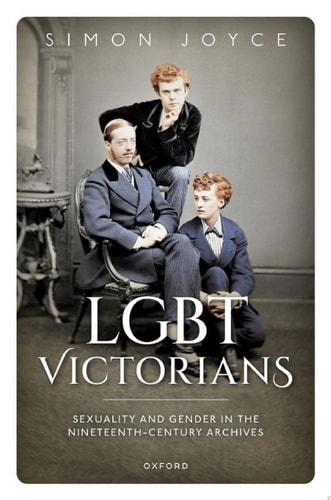
LGBT Victorians: Sexuality and Gender in the Nineteenth-Century Archives
0
0
As an Amazon Associate and affiliate partner, Menrva Books earns from qualifying purchases. Learn more
Author Description
It has been decades since Michel Foucault urged us to rethink "the repressive hypothesis" and see new forms of sexual discourse as coming into being in the nineteenth century, yet the term "Victorian" still has largely negative connotations. LGBT Victorians argues for re-visiting the period's thinking about gender and sexual identity at a time when our queer alliances are fraying. We think of those whose primary self-definition is in terms of sexuality (lesbians, gay men, bisexuals) and those for whom it is gender identity (intersex and transgender people, genderqueers) as simultaneously in coalition and distinct from each other, on the assumption that gender and sexuality are independent aspects of self-identification. Re-examining how the Victorians considered such identity categories to have produced and shaped each other can ground a more durable basis for strengthening our present LGBTQ+ coalition. LGBT Victorians draws on scholarship reconsidering the significance of sexology and efforts to retrospectively discover transgender people in historical archives, particularly in the gap between what the nineteenth century termed the sodomite and the hermaphrodite. It highlights a broad range of individuals (including Anne Lister, and the defendants in the "Fanny and Stella" trial of the 1870s), key thinkers and activists (including Karl-Heinrich Ulrichs and Edward Carpenter), and writers such as Walt Whitman and John Addington Symonds to map the complicated landscape of gender and sexuality in the Victorian period. In the process, it decenters Oscar Wilde and his imprisonment from our historical understanding of sexual and gender nonconformity.
Menrva's Summary
THE THESIS
This work investigates how nineteenth-century conceptualizations of gender and sexuality can inform and strengthen contemporary LGBTQ+ political coalitions. Simon Joyce, a scholar of Victorian literature and culture, utilizes archival research and historical analysis to challenge the assumption that gender and sexuality are independent categories. He argues that by examining how Victorians viewed these identities as mutually constitutive, modern readers can better navigate current debates regarding identity politics and coalition building.
THE SCOPE MAP
What You Will Find
- Analysis of historical figures including Anne Lister, Karl-Heinrich Ulrichs, and Edward Carpenter
- Examination of the legal and social implications of the 'Fanny and Stella' trial
- Re-evaluation of the relationship between sexology and archival records
- A critical shift away from the traditional focus on Oscar Wilde as the primary lens for Victorian nonconformity
Scope Limits
- The text does not provide a comprehensive biography of every mentioned figure
- It does not attempt to apply modern clinical definitions of gender identity to historical subjects without critical qualification
THE AUTHORITY PERSPECTIVE
Scholars and historians recognize this text as a significant intervention in Victorian studies that successfully complicates the traditional narrative of sexual history. Readers frequently note the academic density of the prose, which is intended for those familiar with queer theory and nineteenth-century historical discourse.
Page Count:
296
Publication Date:
2022-01-01
Publisher:
OUP Oxford
ISBN-10:
019267420X
ISBN-13:
9780192674203
History
LGBTQ Studies
Gender Studies
Cultural History
Europe
Educational Resources
Modern History
Sociology
Community Tags
Similar Books