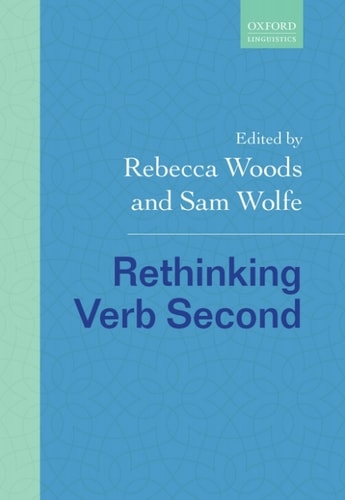
Rethinking Verb Second
0
0
As an Amazon Associate and affiliate partner, Menrva Books earns from qualifying purchases. Learn more
Author Description
This volume provides the most exhaustive and comprehensive treatment available of the Verb Second property, which has been a central topic in formal syntax for decades. While Verb Second has traditionally been considered a feature primarily of the Germanic languages, this book shows that it is much more widely attested cross-linguistically than previously thought, and explores the multiple empirical, theoretical, and experimental puzzles that remain in developing an account of the phenomenon. Uniquely, formal theoretical work appears alongside studies of psycholinguistics, language production, and language acquisition. The range of languages investigated is also broader than in previous work: while novel issues are explored through the lens of the more familiar Germanic data, chapters also cover Verb Second effects in languages such as Armenian, Dinka, Tohono O'odham, and in the Celtic, Romance, and Slavonic families. The analyses have wide-ranging consequences for our understanding of the language faculty, and will be of interest to researchers and students from advanced undergraduate level upwards in the fields of syntax, historical linguistics, and language acquisition.
Menrva's Summary
THE THESIS
This volume investigates the Verb Second (V2) property to determine its prevalence and theoretical implications across a diverse range of global languages. Editors Rebecca Woods and Sam Wolfe compile research from formal syntax, psycholinguistics, and language acquisition to challenge the traditional view that V2 is primarily a Germanic phenomenon. By integrating empirical data with theoretical modeling, the text seeks to refine the current understanding of the language faculty and the mechanisms governing word order.
THE SCOPE MAP
What You Will Find
- Comparative analysis of V2 effects in Germanic, Celtic, Romance, Slavonic, and non-Indo-European languages like Dinka and Tohono O'odham.
- Integration of formal syntactic theory with experimental psycholinguistic data.
- Discussion of language production and acquisition patterns related to V2 structures.
Scope Limits
- The text assumes a foundational knowledge of formal syntax and is intended for advanced students and professional researchers.
- It does not provide an introductory overview of basic syntactic theory for general readers.
THE AUTHORITY PERSPECTIVE
Experts recognize this volume as a comprehensive reference for the current state of V2 research in formal linguistics. Readers frequently note the academic density of the prose, which is tailored specifically for specialists in syntax and historical linguistics.
Page Count:
992
Publication Date:
2020-01-01
Publisher:
OUP Oxford
ISBN-10:
0192582577
ISBN-13:
9780192582577
English
Historical linguistics
English & College Success
Formal Linguistics
Psycholinguistics
Linguistics
Syntax