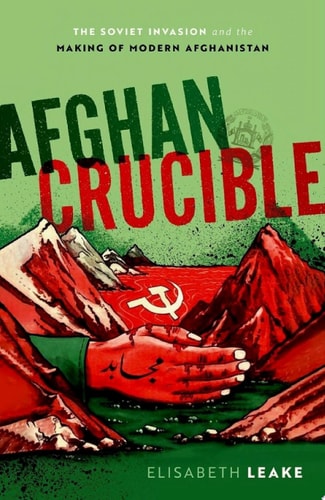
Afghan Crucible: The Soviet Invasion and the Making of Modern Afghanistan
0
0
As an Amazon Associate and affiliate partner, Menrva Books earns from qualifying purchases. Learn more
Author Description
A new global history of the Soviet invasion of Afghanistan - an invasion whose consequences are still felt in Afghanistan and across the wider world. On 24 December 1979, Soviet armed forces entered Afghanistan, beginning an occupation that would last almost a decade and creating a political crisis that shook the world. To many observers, the Soviet invasion showed the lengths to which one of the world's superpowers would go to vie for supremacy in the global Cold War. The Soviet war, and parallel covert American aid to Afghan resistance fighters, would come to be a defining event of international politics in the final years of the Cold War, lingering far beyond the Soviet Union's own demise. Yet Cold War competition is only a small part of the story. Soviet troops entered a country already at war with itself. A century of debates within Afghanistan over the nature of modern nationhood culminated in a 1978 coup in which self-described Afghan communists pledged to fundamentally reshape Afghanistan. Instead what broke out was a civil war in which Afghans asserted competing models of Afghan statehood. Afghan socialists and Islamists came to the fore of this conflict in the 1980s, thanks in part to Soviet and American involvement, but they represented a broader movement for local articulations of social and political modernity that did not derive from foreign models. Afghans, in conversation with foreigners, set many of the parameters of the conflict. This sweeping history moves between centres of state in Kabul, Moscow, Islamabad, and Washington, the halls of global governance in Geneva and New York, resistance hubs in Peshawar and Panjshir, and refugee camps scattered across Pakistan's borderlands to tell a story that is much more expansive than the Soviet invasion of Afghanistan - a global history of a moment of crisis not just for Afghanistan or the Cold War but international relations and the postcolonial state.
Menrva's Summary
THE THESIS
This book investigates how the Soviet invasion of Afghanistan functioned as both a Cold War proxy conflict and a culmination of internal Afghan debates regarding statehood and modernity. Elisabeth Leake, an expert in international history, utilizes a wide array of archival sources and global perspectives to challenge the traditional narrative that frames the conflict solely as a superpower struggle. She argues that Afghan actors were central agents in the conflict, shaping the war's trajectory through their own competing visions for the nation's future.
THE SCOPE MAP
What You Will Find
- A multi-polar analysis of the conflict involving Kabul, Moscow, Islamabad, and Washington.
- Examination of the 1978 coup and the subsequent rise of Afghan socialist and Islamist factions.
- Analysis of the intersection between local political movements and global Cold War dynamics.
Scope Limits
- The text does not provide a minute-by-minute tactical account of military engagements.
- It does not focus exclusively on the post-2001 period, though it acknowledges the long-term consequences of the 1980s.
THE AUTHORITY PERSPECTIVE
Historians and political analysts recognize this work as a significant contribution to the historiography of the Cold War by centering Afghan agency. Readers frequently note the academic rigor and the breadth of the research, which successfully moves the narrative beyond a simple superpower binary.
Page Count:
367
Publication Date:
2022-01-01
Publisher:
OUP Oxford
ISBN-10:
0192584863
ISBN-13:
9780192584861
History
International relations
Military History
Middle Eastern
Asia history
Cold War
Community Tags
Similar Books