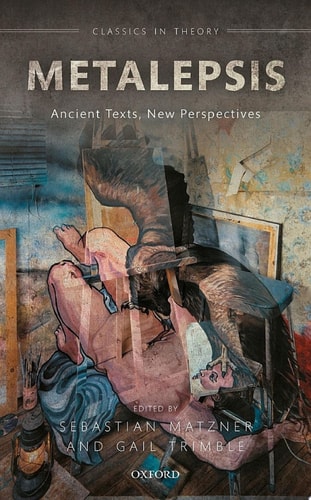
Metalepsis: Ancient Texts, New Perspectives
0
0
As an Amazon Associate and affiliate partner, Menrva Books earns from qualifying purchases. Learn more
Author Description
'Metalepsis' is a term from classical rhetoric, but in the twentieth century, it was re-framed more broadly as a crossing of the boundaries that separate distinct narrative worlds. This modern notion of metalepsis, introduced by Gérard Genette, has so far largely been theorized on the basis of examples from post-modern novels and films. Yet metalepsis has a much greater potential to address all sorts of transgressions between 'worlds' or 'levels', not only in post-modern but also pre-modern literature. This volume explores metalepsis in classical antiquity, considering questions such as: if metalepsis consists fundamentally in the breaking down of barriers, what sort of barriers and what sort of transgressions can the concept be fruitfully applied to? Can it be used within approaches other than narratology? Does metalepsis require recognisable levels of reality and fictionality, and if so, what role might be played by other planes, such as the past, the mythical or the divine? What form does metalepsis take in less obviously 'narrative' genres, such as lyric poetry? And how should it be understood in visual media? Reflecting on these questions sheds new light on important dynamics in ancient texts, and advances literary theory by probing how explorations of ancient metalepsis might change, refine, or extend our understanding of the concept itself.
Menrva's Summary
THE THESIS
This volume investigates the applicability of the narratological concept of metalepsis—the transgression of boundaries between narrative worlds—to the literature and visual media of classical antiquity. Editors Gail Trimble and Sebastian Matzner curate a collection of scholarly essays that challenge the modern, post-modern-centric definition of the term. By applying this framework to pre-modern texts, the contributors argue that metalepsis serves as a versatile analytical tool for understanding the complex interplay between reality, myth, and divinity in ancient works.
THE SCOPE MAP
What You Will Find
- Theoretical re-evaluations of Gérard Genette’s original definition of metalepsis.
- Analyses of boundary-crossing in non-narrative genres, specifically lyric poetry.
- Investigations into the intersection of visual media and literary narrative structures.
- Explorations of how ancient concepts of the divine and the mythical interact with fictionality.
Scope Limits
- The volume focuses primarily on classical antiquity and does not provide an exhaustive survey of post-modern literature.
- It does not attempt to create a singular, unified theory of metalepsis, but rather presents a variety of methodological approaches.
THE AUTHORITY PERSPECTIVE
Scholars in the field of classics and narratology recognize this work as a significant expansion of the theoretical discourse surrounding boundary-crossing in literature. Readers frequently note the academic density of the prose, which is intended for researchers and advanced students of literary theory.
Page Count:
334
Publication Date:
2020-01-01
Publisher:
OUP Oxford
ISBN-10:
0192586300
ISBN-13:
9780192586308
Philosophy
History & Surveys
English
Ancient
English & College Success
Literary Criticism
Narratology
Rhetoric