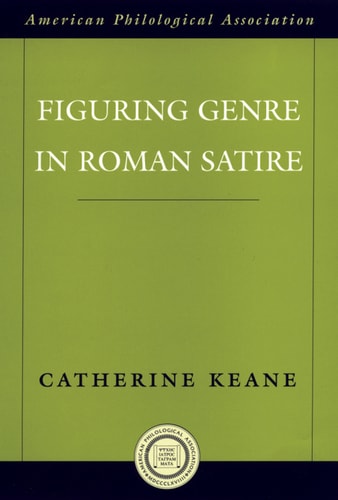
Figuring Genre in Roman Satire
0
0
As an Amazon Associate and affiliate partner, Menrva Books earns from qualifying purchases. Learn more
Author Description
Satirists are social critics, but they are also products of society. Horace, Persius, and Juvenal, the verse satirists of ancient Rome, exploit this double identity to produce their colorful commentaries on social life and behavior. In a fresh comparative study that combines literary and cultural analysis, Catherine Keane reveals how the satirists create such a vivid and incisive portrayal of the Roman social world. Throughout the tradition, the narrating satirist figure does not observe human behavior from a distance, but adopts a range of charged social roles to gain access to his subject matter. In his mission to entertain and moralize, he poses alternately as a theatrical performer and a spectator, a perpetrator and victim of violence, a jurist and criminal, a teacher and student. In these roles the satirist conducts penetrating analyses of Rome's definitive social practices "from the inside." Satire's reputation as the quintessential Roman genre is thus even more justified than previously recognized.As literary artists and social commentators, the satirists rival the grandest authors of the classical canon. They teach their ancient and modern readers two important lessons. First, satire reveals the inherent fragilities and complications, as well as acknowledging the benefits, of Roman society's most treasured institutions. The satiric perspective deepens our understanding of Roman ideologies and their fault lines. As the poets show, no system of judgment, punishment, entertainment, or social organization is without its flaws and failures. At the same time, readers are encouraged to view the satiric genre itself as a composite of these systems, loaded with cultural meaning and highly imperfect. The satirist who functions as both subject and critic trains his readers to develop a critical perspective on every kind of authority, including his own.
Menrva's Summary
THE THESIS
This study investigates how Roman verse satirists utilize their dual identity as social critics and products of their environment to construct complex, incisive portrayals of Roman social life. Catherine Keane, a scholar of classical literature, employs a comparative methodology that integrates literary analysis with cultural history to examine the works of Horace, Persius, and Juvenal. She argues that the satirist functions as an active participant within the social systems they critique, adopting various roles—such as teacher, victim, or performer—to expose the inherent fragilities of Roman institutions.
THE SCOPE MAP
What You Will Find
- Comparative analysis of the verse satirists Horace, Persius, and Juvenal
- Examination of the satirist as a multi-faceted social actor
- Exploration of Roman social institutions including judgment, punishment, and entertainment
- Analysis of the intersection between literary form and cultural ideology
Scope Limits
- The study focuses specifically on the Roman verse satire tradition and does not extend to prose satire or later post-classical developments
- The analysis is limited to the specific satiric figures identified in the canon of Horace, Persius, and Juvenal
THE AUTHORITY PERSPECTIVE
Scholars and students of classical literature frequently cite this work for its nuanced approach to the performative nature of the satiric voice. The text is recognized as a significant contribution to understanding how Roman authors navigated the tension between moralizing authority and social critique.
Page Count:
189
Publication Date:
2006-01-01
Publisher:
Oxford University Press
ISBN-10:
0190293047
ISBN-13:
9780190293048
Satire
English
Roman History
Ancient
Literary Criticism
English & College Success
Community Tags
Other Editions(2)
Similar Books








Reader Comments
Share Your Thoughts
No comments yet. Be the first to share your thoughts!