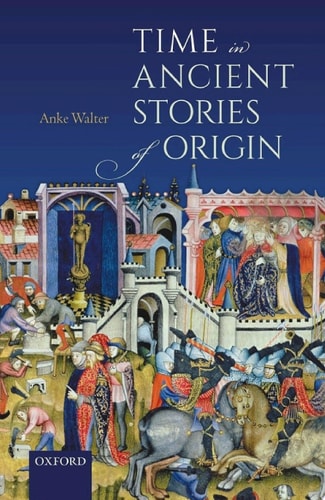
Time in Ancient Stories of Origin
0
0
As an Amazon Associate and affiliate partner, Menrva Books earns from qualifying purchases. Learn more
Author Description
Greek and Roman stories of origin, or aetia, provide a fascinating window onto ancient conceptions of time. Aetia pervade ancient literature at all its stages, and connect the past with the present by telling us which aspects of the past survive "even now" or "ever since then". Yet, while the standard aetiological formulae remain surprisingly stable over time, the understanding of time that lies behind stories of origin undergoes profound changes. By studying a broad range of texts and by closely examining select stories of origin from archaic Greece, Hellenistic Greece, Augustan Rome, and early Christian literature, Time in Ancient Stories of Origin traces the changing forms of stories of origin and the underlying changing attitudes to time: to the interaction of the time of gods and men, to historical time, to change and continuity, as well as to a time beyond the present one. Walter provides a model of how to analyse the temporal construction of aetia, by combining close attention to detail with a view towards the larger temporal agenda of each work. In the process, new insights are provided both into some of the best-known aetiological works of antiquity (e.g. by Hesiod, Callimachus, Vergil, Ovid) and lesser-known works (e.g. Ephorus, Prudentius, Orosius). This volume shows that aetia do not merely convey factual information about the continuity of the past, but implicate the present in ever new complex messages about time.
Menrva's Summary
THE THESIS
This work investigates how the conceptualization of time within ancient stories of origin, or aetia, evolved across different periods of Greek and Roman antiquity. Anke Walter, a scholar of classical literature, utilizes a comparative analysis of aetiological texts to argue that while the formal structure of these stories remained consistent, the underlying temporal philosophy shifted significantly. By examining the interaction between divine and human time, the author demonstrates how these narratives served as complex mechanisms for linking the past to the present.
THE SCOPE MAP
What You Will Find
- Analysis of aetiological texts from archaic Greece, Hellenistic Greece, Augustan Rome, and early Christian literature.
- A methodological framework for analyzing the temporal construction of origin stories.
- Comparative studies of major authors including Hesiod, Callimachus, Vergil, and Ovid alongside lesser-known figures like Ephorus and Prudentius.
Scope Limits
- The study focuses primarily on the temporal dimensions of aetia rather than a comprehensive historical survey of all ancient origin myths.
- The analysis is restricted to specific literary examples rather than an exhaustive catalog of every extant aetiological work.
THE AUTHORITY PERSPECTIVE
Scholars recognize this volume as a rigorous contribution to the study of ancient temporalities and aetiological literature. Readers frequently note the academic density of the prose, which is intended for specialists in classical philology and literary history.
Page Count:
290
Publication Date:
2020-01-01
Publisher:
OUP Oxford
ISBN-10:
0192582046
ISBN-13:
9780192582041
History
Ancient
English
English & College Success
Cultural History
Literary Criticism
Community Tags
Similar Books