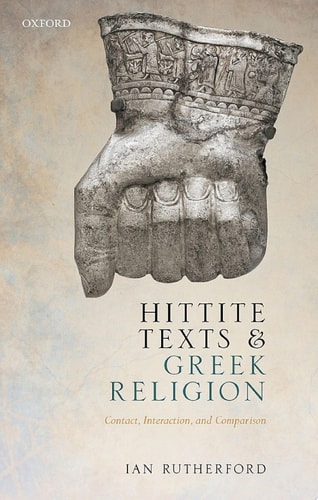
Hittite Texts and Greek Religion: Contact, Interaction, and Comparison
0
0
As an Amazon Associate and affiliate partner, Menrva Books earns from qualifying purchases. Learn more
Author Description
Our knowledge of ancient Greece has been transformed in the last century by an increased understanding of the cultures of the Ancient Near East. This is particularly true of ancient religion. This book looks at the relationship between the religious systems of Ancient Greece and the Hittites, who controlled Turkey in the Late Bronze Age (1400-1200 BC). The cuneiform texts preserved in the Hittite archives provide a particularly rich source for religious practice, detailing festivals, purification rituals, oracle-consultations, prayers, and myths of the Hittite state, as well as documenting the religious practice of neighbouring Anatolian states in which the Hittites took an interest. Hittite religion is thus more comprehensively documented than any other ancient religious tradition in the Near East, even Egypt. The Hittites are also known to have been in contact with Mycenaean Greece, known to them as Ahhiyawa. The book first sets out the evidence and provides a methodological paradigm for using comparative data. It then explores cases where there may have been contact or influence, such as in the case of scapegoat rituals or the Kumarbi-Cycle. Finally, it considers key aspects of religious practices shared by both systems, such as the pantheon, rituals of war, festivals, and animal sacrifice. The aim of such a comparison is to discover clues that may further our understanding of the deep history of religious practices and, when used in conjunction with historical data, illuminate the differences between cultures and reveal what is distinctive about each of them.
Menrva's Summary
THE THESIS
This book investigates the historical and cultural intersections between the religious systems of the Hittite Empire and Ancient Greece during the Late Bronze Age. Ian Rutherford, a scholar of classics and ancient religion, utilizes a comparative methodology to analyze cuneiform archives and Mycenaean historical data. He argues that by examining shared ritualistic practices and mythological frameworks, researchers can better understand the deep history of religious development in the Mediterranean and Anatolian regions.
THE SCOPE MAP
What You Will Find
- Comparative analysis of Hittite cuneiform texts and Mycenaean religious records.
- Methodological frameworks for cross-cultural religious study.
- Case studies on specific phenomena including scapegoat rituals, the Kumarbi-Cycle, and animal sacrifice.
- Examination of the pantheon and war-related rituals in both cultures.
Scope Limits
- The analysis is primarily restricted to the Late Bronze Age period (1400-1200 BC).
- The text focuses on specific points of contact or comparison rather than providing a comprehensive history of either individual religion.
THE AUTHORITY PERSPECTIVE
Scholars and students of ancient history recognize this work as a significant contribution to the field of comparative religious studies. Readers frequently note the academic density of the prose and the rigorous methodology applied to the interpretation of cuneiform evidence.
Page Count:
416
Publication Date:
2020-01-01
Publisher:
OUP Oxford
ISBN-10:
019259995X
ISBN-13:
9780192599957
History
Religion
Archaeology
Ancient History
Community Tags
Similar Books