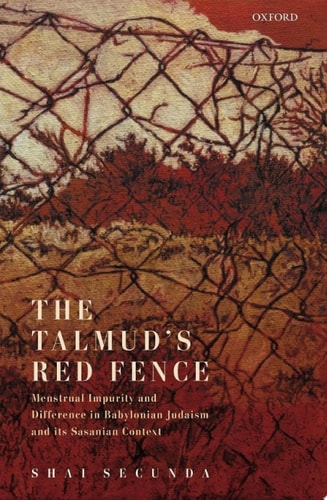
The Talmud's Red Fence: Menstrual Impurity and Difference in Babylonian Judaism and Its Sasanian Context
0
0
As an Amazon Associate and affiliate partner, Menrva Books earns from qualifying purchases. Learn more
Author Description
The Talmud's Red Fence explores how rituals and beliefs concerning menstruation in the Babylonian Talmud and neighboring Sasanian religious texts were animated by difference and differentiation. It argues that the practice and development of menstrual rituals in Babylonian Judaism was a product of the religious terrain of the Sasanian Empire, where groups like Syriac Christians, Mandaeans, Zoroastrians, and Jews defined themselves in part based on how they approached menstrual impurity. It demonstrates that menstruation was highly charged in Babylonian Judaism and Sasanian Zoroastrian, where menstrual discharge was conceived of as highly productive female seed yet at the same time as stemming from either primordial sin (Eve eating from the tree) or evil (Ahrimen's kiss). It argues that competition between rabbis and Zoroastrians concerning menstrual purity put pressure on the Talmudic system, for instance in the unusual development of an expert diagnostic system of discharges. It shows how Babylonian rabbis seriously considered removing women from the home during the menstrual period, as Mandaeans and Zoroastrians did, yet in the end deemed this possibility too "heretical." Finally, it examines three cases of Babylonian Jewish women initiating menstrual practices that carved out autonomous female space. One of these, the extension of menstrual impurity beyond the biblically mandated seven days, is paralleled in both Zoroastrian Middle Persian and Mandaic texts. Ultimately, Talmudic menstrual purity is shown to be driven by difference in its binary structure of pure and impure; in gendered terms; on a social axis between Jews and Sasanian non-Jewish communities; and textually in the way the Palestinian and Babylonian Talmuds took shape in late antiquity.
Menrva's Summary
THE THESIS
This work investigates how the Babylonian Talmudic laws regarding menstrual impurity were shaped by the competitive religious environment of the Sasanian Empire. Shai Secunda, a scholar of rabbinic literature, utilizes a comparative framework to analyze how Jewish, Zoroastrian, Mandaean, and Syriac Christian communities defined their identities through distinct purity practices. The author argues that the specific development of Talmudic menstrual regulations was not an isolated internal evolution but a reaction to the social and theological pressures of neighboring Sasanian cultures.
THE SCOPE MAP
What You Will Find
- Comparative analysis of menstrual impurity laws in the Babylonian Talmud, Middle Persian Zoroastrian texts, and Mandaic literature.
- Examination of the diagnostic systems developed by rabbis to categorize menstrual discharges.
- Case studies of female-initiated practices that established autonomous spaces within the domestic sphere.
Scope Limits
- The study focuses primarily on the Sasanian context and does not provide an exhaustive history of menstrual law in later medieval or modern Jewish practice.
- It does not attempt to provide a comprehensive sociological survey of all women's lives in the Sasanian Empire, focusing instead on the textual and legal representations of impurity.
THE AUTHORITY PERSPECTIVE
Scholars in the field of late antiquity and rabbinic studies recognize this text as a significant contribution to the understanding of how religious identity is constructed through ritual boundary-marking. Readers frequently note the academic density of the prose and the author's meticulous engagement with both primary source material and the broader Sasanian cultural landscape.
Page Count:
221
Publication Date:
2020-01-01
Publisher:
OUP Oxford
ISBN-10:
0192598899
ISBN-13:
9780192598899
History
Religion
Sociology of Religion
Women in Zoroastrianism
In literature
Menstruation
Gender Studies
Judaism
Ancient History
Community Tags
Similar Books