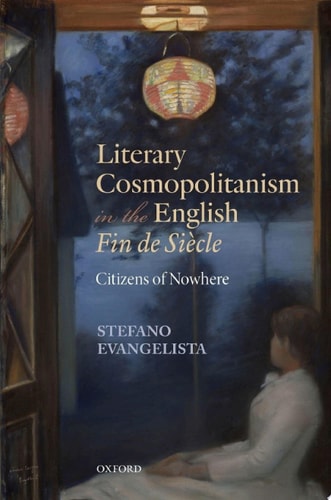
Literary Cosmopolitanism in the English Fin de Siècle: Citizens of Nowhere
0
0
As an Amazon Associate and affiliate partner, Menrva Books earns from qualifying purchases. Learn more
Author Description
The fin de siècle witnessed an extensive and heated debate about cosmopolitanism, which transformed readers' attitudes towards national identity, foreign literatures, translation, and the idea of world literature. Focussing on literature written in English, Literary Cosmopolitanism in the English Fin de Siècle offers a critical examination of cosmopolitanism as a distinctive feature of the literary modernity of this important period of transition. No longer conceived purely as an abstract philosophical ideal, cosmopolitanism--or world citizenship--informed the actual, living practices of authors and readers who sought new ways of relating local and global identities in an increasingly interconnected world. The book presents literary cosmopolitanism as a field of debate and controversy. While some writers and readers embraced the creative, imaginative, emotional, and political potentials of world citizenship, hostile critics denounced it as a politically and morally suspect ideal, and stressed instead the responsibilities of literature towards the nation. In this age of empire and rising nationalism, world citizenship came to enshrine a paradox: it simultaneously connoted positions of privilege and marginality, connectivity and non-belonging. Chapters on Oscar Wilde, Lafcadio Hearn, George Egerton, the periodical press, and artificial languages bring to light the variety of literary responses to the idea of world citizenship that proliferated at the turn of the twentieth century. The book interrogates cosmopolitanism as a liberal ideology that celebrates human diversity and as a social identity linked to worldliness; it investigates its effect on gender, ethics, and the emotions. It presents the literature of the fin de siècle as a dynamic space of exchange and mediation, and argues that our own approach to literary studies should become less national in focus.
Menrva's Summary
THE THESIS
This book investigates how the concept of cosmopolitanism functioned as a central, contested ideology within English literature during the fin de siècle period. Stefano Evangelista, a scholar of nineteenth-century literature, utilizes a historical and critical framework to analyze how authors and readers navigated the tension between national identity and global citizenship. By examining the period's literature as a site of debate, the author argues that cosmopolitanism was not merely an abstract ideal but a practical, lived experience that shaped literary modernity.
THE SCOPE MAP
What You Will Find
- Analysis of the intersection between national identity, translation, and world literature.
- Case studies on specific authors including Oscar Wilde, Lafcadio Hearn, and George Egerton.
- Examination of the role of the periodical press and artificial languages in promoting global connectivity.
- Discussion of the paradox of world citizenship as both a position of privilege and marginality.
Scope Limits
- The study is primarily focused on literature written in English rather than a global survey of all fin de siècle writing.
- It does not provide an exhaustive history of cosmopolitan philosophy, focusing instead on its specific literary manifestations at the turn of the twentieth century.
THE AUTHORITY PERSPECTIVE
Scholars recognize this work as a significant contribution to the study of literary modernity and the shifting boundaries of national identity. Readers frequently note the academic density of the prose and the author's ability to synthesize complex historical debates into a coherent literary framework.
Page Count:
304
Publication Date:
2021-01-01
Publisher:
OUP Oxford
ISBN-10:
0192609831
ISBN-13:
9780192609830
History
19th Century
Fin de Siècle
Indigenous
English literature
World Literature
Literary Criticism
Community Tags
Similar Books