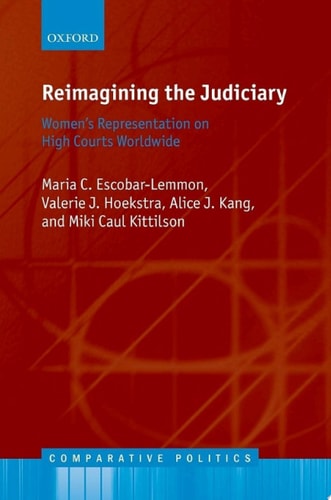
Reimagining the Judiciary: Women's Representation on High Courts Worldwide
0
0
As an Amazon Associate and affiliate partner, Menrva Books earns from qualifying purchases. Learn more
Author Description
This book examines the factors that facilitate the inclusion of women on high courts, while recognizing that many courts have a long way to go before reaching gender parity. Why did women start appearing on high courts when they did? Where have women made the most significant strides? To address these questions, the authors built the first cross-national and longitudinal dataset on the appointment of women and men to high courts. In addition, they provide five in-depth country case studies us to unpack the selection of justices to high courts in Canada, Colombia, Ireland, South Africa, and the United States. The cross-national lens and combination of quantitative analyses and detailed country studies examines multiple influences across region and time. Focusing on three sets of explanations --pipelines to high courts, domestic institutions, and international influences- analyses reveal that women are more likely to first appear on their country's high court when traditional ideas about who can and should be a judge erode. In some countries, international treaties, regional emulation, and women's international NGOs play a role in disseminating and linking global norms of gender equality in decision-making. Importantly, while informal institutions and reliance on men-dominated networks can limit access, women are making substantial strides in their countries' highest courts where the supply grows, and often where selectors have incentives to select women. Further, sustained pressure from advocacy organizations-at the local, national, and global levels-contributes to some gains. Comparative Politics is a series for researchers, teachers, and students of political science that deals with contemporary government and politics. Global in scope, books in the series are characterized by a stress on comparative analysis and strong methodological rigour. The series is published in association with the European Consortium for Political Research.
Menrva's Summary
THE THESIS
This book investigates the systemic factors and institutional conditions that facilitate the inclusion of women on high courts across diverse national contexts. The authors, a team of political science scholars, utilize a mixed-methods approach to analyze why women gain access to judicial power and how global norms interact with domestic political structures. By synthesizing a new longitudinal dataset with qualitative case studies, the work provides a framework for understanding the erosion of traditional judicial barriers and the influence of advocacy networks.
THE SCOPE MAP
What You Will Find
- A comprehensive cross-national and longitudinal dataset on high court appointments.
- In-depth case studies of Canada, Colombia, Ireland, South Africa, and the United States.
- Analysis of three primary explanatory factors: professional pipelines, domestic institutions, and international influences.
Scope Limits
- The study focuses specifically on high courts rather than lower-level judicial bodies.
- It does not provide an exhaustive history of every nation's judicial system, focusing instead on comparative trends.
THE AUTHORITY PERSPECTIVE
Experts in political science and legal studies recognize this work as a rigorous contribution to the study of judicial selection and gender representation. Readers frequently note the academic density of the prose and the value of the authors' methodological approach in bridging quantitative data with nuanced country-specific analysis.
Page Count:
215
Publication Date:
2022-01-01
Publisher:
OUP Oxford
ISBN-10:
0192606026
ISBN-13:
9780192606020
Sociology
Judiciary
Gender Studies
Comparative Politics
Law
Community Tags
Similar Books










Reader Comments
Share Your Thoughts
No comments yet. Be the first to share your thoughts!