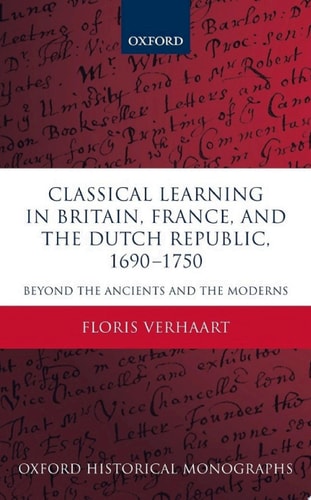
Classical Learning in Britain, France, and the Dutch Republic, 1690-1750: Beyond the Ancients and the Moderns
0
0
As an Amazon Associate and affiliate partner, Menrva Books earns from qualifying purchases. Learn more
Author Description
For much of western history, the achievements of classical antiquity were seen as unsurpassable, and works by Latin and Greek authors were viewed as treasure troves of information still useful for contemporary society. By the late seventeenth century, however, the progress of scientific discoveries and the new paradigms of rationalism and empiricism meant the authority of the ancients was called into question. Those working on the classical past and its literature debated new ways of defending their relevance for society. The different approaches to classical literature defended in these debates explain how the writings of ancient Greece and Rome could become a vital part of eighteenth-century culture and political thinking. Floris Verhaart analyses these eighteenth-century debates about the value of classics, arguing that the Enlightenment, though often seen as an age of reason and modernity, in fact continuously sought inspiration from preceding traditions and ages such as Renaissance humanism and classical antiquity. The volume offers an interesting parallel with the modern day, in which the relationship between 'experts' and the general public has become the topic of debate and many academics, especially in the humanities, face pressure to explain how their work benefits society at large.
Menrva's Summary
THE THESIS
This work investigates how scholars in Britain, France, and the Dutch Republic navigated the shifting relevance of classical antiquity amidst the rise of Enlightenment rationalism and scientific progress. Floris Verhaart, a specialist in intellectual history, examines the intellectual defense of classical literature during the period between 1690 and 1750. By analyzing contemporary debates, the author argues that the Enlightenment was not a clean break from the past but rather a period that actively synthesized Renaissance humanism and ancient traditions to address modern societal needs.
THE SCOPE MAP
What You Will Find
- Comparative analysis of intellectual discourse in Britain, France, and the Dutch Republic
- Examination of the transition from classical authority to modern rationalist paradigms
- Historical context regarding the role of humanities scholars in public life
Scope Limits
- The study is restricted to the specific timeframe of 1690 to 1750
- The analysis focuses primarily on the defense of classical literature rather than a comprehensive history of all classical studies
THE AUTHORITY PERSPECTIVE
Scholars recognize this monograph as a rigorous contribution to the intellectual history of the early eighteenth century. Experts highlight the text's ability to draw meaningful parallels between the historical crisis of the humanities and contemporary academic challenges.
Page Count:
256
Publication Date:
2020-01-01
Publisher:
OUP Oxford
ISBN-10:
0192606182
ISBN-13:
9780192606181
History
Philosophy
European History
Enlightenment
Special Topics
Intellectual History
Community Tags
Similar Books