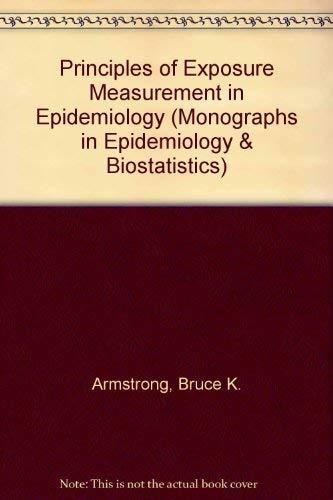
Principles of Exposure Measurement in Epidemiology
0
0
As an Amazon Associate and affiliate partner, Menrva Books earns from qualifying purchases. Learn more
Author Description
Most of the research in epidemiology attempts to relate exposure to external agents to the occurrence of particular diseases. However, this research depends critically on accurate measurement of exposure. Armstrong's work assimilates, in a single source, the principles and techniques of exposure measurement as they relate specifically to causes of non-infectious diseases. It draws on experience and results from many different disciplines (including psychology, survey research, sociology, environmental hygiene, epidemiology, and biostatistics) and synthesizes them for direct practical application in epidemiological and related research. In addition, the volume covers questionnaire design, conducting personal interviews, abstracting information from medical records, use of proxy respondents, and use of biological and environmental measurements. It gives a comprehensive account of measurement effects, and the design, analysis, and interpretation of validity and reliability studies. Emphasis is given to the methods by which the validity of measurements can be increased. Techniques to maximize participation of subjects in epidemiological studies are discussed, and ethical issues relevant to exposure measurement are outlined. The book will be useful as a handbook for anyone wishing to design or conduct an epidemiological study and can also be used as a graduate text for an exposure measurement in epidemiology course.
Menrva's Summary
THE THESIS
This volume investigates the fundamental principles and practical techniques required for the accurate measurement of exposure to external agents in the study of non-infectious diseases. Authors Bruce K. Armstrong, Emily White, and Rodolfo Saracci synthesize methodologies from diverse fields including psychology, sociology, and environmental hygiene to provide a unified framework for epidemiological research. The text serves as a technical guide for designing studies, ensuring data validity, and interpreting reliability in the context of disease causation.
THE SCOPE MAP
What You Will Find
- Methodologies for questionnaire design and personal interviewing techniques
- Protocols for abstracting data from medical records and utilizing proxy respondents
- Analysis of biological and environmental measurement techniques
- Frameworks for assessing validity and reliability in study design
- Strategies for maximizing subject participation and addressing ethical considerations
Scope Limits
- The text focuses primarily on non-infectious diseases rather than infectious disease transmission models
- It does not provide an exhaustive review of advanced computational statistical software packages
THE AUTHORITY PERSPECTIVE
Experts and researchers frequently cite this work as a foundational handbook for designing and conducting rigorous epidemiological studies. Readers often note the technical density of the prose, which makes it well-suited for graduate-level coursework and professional reference.
Page Count:
368
Publication Date:
1992-12-03
Publisher:
Oxford University Press
ISBN-10:
0192617052
ISBN-13:
9780192617057
Epidemiology
Statistics
Public Health
Biostatistics