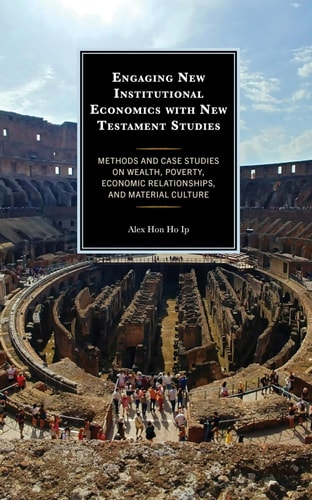
Engaging New Institutional Economics with New Testament Studies: Methods and Case Studies on Wealth, Poverty, Economic Relationships, and Material Culture
0
0
As an Amazon Associate and affiliate partner, Menrva Books earns from qualifying purchases. Learn more
Author Description
In Engaging New Institutional Economics with New Testament Studies: Methods and Case Studies on Wealth, Poverty, Economic Relationships, and Material Culture, the intersection of economics and biblical scholarship takes center stage, offering a groundbreaking approach to understanding the economic underpinnings of the New Testament. This book explores how the vast economic landscape of the Roman Empire shaped early Christian communities, delving into themes of wealth, poverty, and material culture through the lens of New Institutional Economics (NIE). The book also conducts a thorough literature review, addressing a common misunderstanding rooted in the confusing use of the term "economics." Many scholars have narrowly assumed that economics refers exclusively to neo-classical economics. However, this work deliberately advocates for the merits of NIE, demonstrating how it offers a more nuanced framework for analyzing the economic realities of the ancient world and their impact on New Testament narratives. Through detailed case studies, including an analysis of wealth possession in the Gospel of Luke, the book illustrates how NIE can unlock new insights into the New Testament's engagement with economic structures. Far from being merely an academic exercise, this book argues that the New Testament offers profound wisdom for navigating the ethical and moral complexities of economic behavior in the modern world. Scholars and readers alike will find a valuable resource for exploring the rich, yet often overlooked, economic dimensions of the New Testament.
Menrva's Summary
THE THESIS
This book investigates how New Institutional Economics (NIE) can illuminate the economic realities and social structures described in the New Testament. It examines the economic landscape of the Roman Empire and its influence on early Christian communities, focusing on themes of wealth, poverty, and material culture. The author advocates for NIE as a superior analytical framework to neo-classical economics for understanding ancient economic systems, using case studies to demonstrate its application to New Testament narratives and their relevance to modern economic ethics.
THE SCOPE MAP
- Application of New Institutional Economics (NIE) to New Testament Studies
- Analysis of wealth, poverty, and material culture in the Roman Empire's economic context
- Case studies on economic themes in specific New Testament texts, including the Gospel of Luke
- Literature review addressing common misunderstandings of 'economics' in scholarship
- Exploration of the ethical and moral dimensions of economic behavior in both ancient and modern contexts
THE AUTHORITY PERSPECTIVE
The book offers a novel approach by integrating New Institutional Economics with New Testament scholarship, aiming to provide a more nuanced understanding of the economic aspects within biblical texts. It addresses a perceived limitation in existing scholarship by challenging the narrow application of neo-classical economics. The work is positioned as a valuable resource for scholars and readers interested in the economic dimensions of the New Testament and their contemporary ethical implications.
Page Count:
190
Publication Date:
2025-03-05
Publisher:
Bloomsbury Academic
ISBN-10:
1978713681
ISBN-13:
9781978713680
Religion
Non-Fiction
History
Ancient History
Economic History
Community Tags
Similar Books