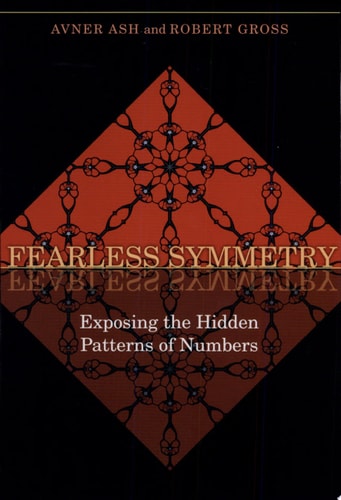
Fearless Symmetry: Exposing the Hidden Patterns of Numbers
0
0
As an Amazon Associate and affiliate partner, Menrva Books earns from qualifying purchases. Learn more
Author Description
Mathematicians solve equations, or try to. But sometimes the solutions are not as interesting as the beautiful symmetric patterns that lead to them. Written in a friendly style for a general audience, Fearless Symmetry is the first popular math book to discuss these elegant and mysterious patterns and the ingenious techniques mathematicians use to uncover them. Hidden symmetries were first discovered nearly two hundred years ago by French mathematician Évariste Galois. They have been used extensively in the oldest and largest branch of mathematics--number theory--for such diverse applications as acoustics, radar, and codes and ciphers. They have also been employed in the study of Fibonacci numbers and to attack well-known problems such as Fermat's Last Theorem, Pythagorean Triples, and the ever-elusive Riemann Hypothesis. Mathematicians are still devising techniques for teasing out these mysterious patterns, and their uses are limited only by the imagination. The first popular book to address representation theory and reciprocity laws, Fearless Symmetry focuses on how mathematicians solve equations and prove theorems. It discusses rules of math and why they are just as important as those in any games one might play. The book starts with basic properties of integers and permutations and reaches current research in number theory. Along the way, it takes delightful historical and philosophical digressions. Required reading for all math buffs, the book will appeal to anyone curious about popular mathematics and its myriad contributions to everyday life.
Menrva's Summary
THE THESIS
The book investigates the profound beauty and utility of hidden symmetries in mathematics, particularly within number theory.
Written for a general audience, Fearless Symmetry explores the elegant and mysterious patterns that underpin mathematical solutions, moving beyond mere equation-solving to reveal the ingenious techniques mathematicians employ. The authors, Avner Ash and Robert Gross, trace the discovery of these symmetries back to Évariste Galois nearly two centuries ago. They demonstrate their extensive application in number theory, impacting fields from acoustics and radar to cryptography, and their role in tackling famous mathematical problems like Fermat's Last Theorem and the Riemann Hypothesis. The book emphasizes that the discovery and application of these patterns are ongoing, limited only by imagination.
THE SCOPE MAP
- Exploration of hidden symmetries in mathematics, with a focus on number theory.
- Discussion of the historical discovery of symmetries by Évariste Galois.
- Applications of symmetries in diverse fields such as acoustics, radar, and codes/ciphers.
- Connections to well-known mathematical problems including Fermat's Last Theorem and the Riemann Hypothesis.
- Explanation of mathematical rules and their importance, akin to game rules.
- Coverage of basic properties of integers and permutations, progressing to current research.
- Inclusion of historical and philosophical digressions.
THE AUTHORITY PERSPECTIVE
The book is presented as required reading for math enthusiasts and appeals to anyone interested in popular mathematics and its real-world contributions. Its approach focuses on how mathematicians solve equations and prove theorems, highlighting the elegance of mathematical rules. The text is noted for its friendly style, making complex topics accessible to a general audience. It covers a broad spectrum from basic number properties to advanced research, enriched by historical and philosophical insights.
Page Count:
272
Publication Date:
2006-01-01
Publisher:
Princeton University Press
ISBN-10:
0691124922
ISBN-13:
9780691124926
Science
Non-Fiction
Popular Science
Number Theory
Mathematics
Community Tags
Similar Books