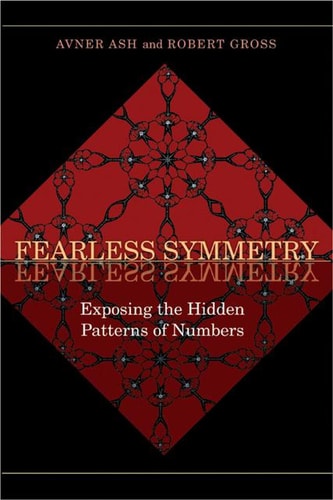
Fearless Symmetry: Exposing the Hidden Patterns of Numbers - New Edition
0
0
As an Amazon Associate and affiliate partner, Menrva Books earns from qualifying purchases. Learn more
Author Description
Mathematicians solve equations, or try to. But sometimes the solutions are not as interesting as the beautiful symmetric patterns that lead to them. Written in a friendly style for a general audience, Fearless Symmetry is the first popular math book to discuss these elegant and mysterious patterns and the ingenious techniques mathematicians use to uncover them. Hidden symmetries were first discovered nearly two hundred years ago by French mathematician évariste Galois. They have been used extensively in the oldest and largest branch of mathematics--number theory--for such diverse applications as acoustics, radar, and codes and ciphers. They have also been employed in the study of Fibonacci numbers and to attack well-known problems such as Fermat's Last Theorem, Pythagorean Triples, and the ever-elusive Riemann Hypothesis. Mathematicians are still devising techniques for teasing out these mysterious patterns, and their uses are limited only by the imagination. The first popular book to address representation theory and reciprocity laws, Fearless Symmetry focuses on how mathematicians solve equations and prove theorems. It discusses rules of math and why they are just as important as those in any games one might play. The book starts with basic properties of integers and permutations and reaches current research in number theory. Along the way, it takes delightful historical and philosophical digressions. Required reading for all math buffs, the book will appeal to anyone curious about popular mathematics and its myriad contributions to everyday life.
Menrva's Summary
THE THESIS
The book investigates the elegant and mysterious symmetric patterns that underpin mathematical solutions, moving beyond mere problem-solving to explore the beauty of the methods themselves. Written in a friendly style for a general audience, Fearless Symmetry delves into the ingenious techniques mathematicians employ to uncover these hidden symmetries, first discovered by Évariste Galois nearly two hundred years ago. The book demonstrates their extensive use in number theory, with applications ranging from acoustics and radar to codes and ciphers, and their role in tackling famous problems like Fermat's Last Theorem and the Riemann Hypothesis. It emphasizes the importance of mathematical rules and how they function, starting with basic properties of integers and permutations and progressing to current research.
THE SCOPE MAP
- Exploration of representation theory and reciprocity laws, presented in a popular math context.
- Discussion of the historical development of symmetry in mathematics, starting with Évariste Galois.
- Applications of number theory and symmetry in diverse fields such as acoustics, radar, and cryptography.
- Analysis of how symmetries are used to address well-known mathematical problems like Fermat's Last Theorem and the Riemann Hypothesis.
- Examination of the fundamental properties of integers and permutations as a starting point.
- Progression to current research in number theory, showcasing ongoing mathematical inquiry.
- Inclusion of historical and philosophical digressions to enrich the reader's understanding.
- Focus on the process of solving equations and proving theorems, highlighting the beauty of mathematical rules.
THE AUTHORITY PERSPECTIVE
The book is positioned as required reading for math enthusiasts and anyone curious about popular mathematics and its real-world contributions. Its accessible style and focus on the beauty of mathematical patterns suggest it aims to engage a broad audience beyond professional mathematicians. The inclusion of historical and philosophical insights indicates a desire to contextualize mathematical concepts within a wider intellectual landscape. The progression from basic principles to current research implies a comprehensive yet approachable overview of the subject.
Page Count:
312
Publication Date:
2008-08-04
Publisher:
Princeton University Press
ISBN-10:
1400837774
ISBN-13:
9781400837779
Science
Non-Fiction
Popular Science
Number Theory
Mathematics
Community Tags
Similar Books