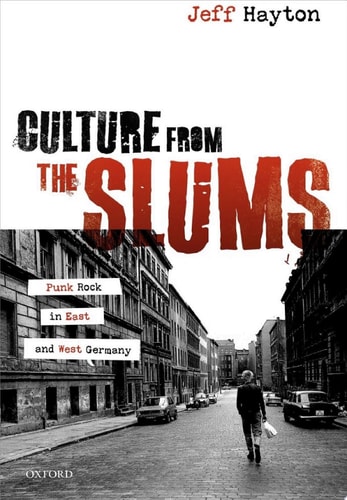
Culture from the Slums: Punk Rock in East and West Germany
0
0
As an Amazon Associate and affiliate partner, Menrva Books earns from qualifying purchases. Learn more
Author Description
Culture from the Slums explores the history of punk rock in East and West Germany during the 1970s and 1980s. These decades witnessed an explosion of alternative culture across divided Germany, and punk was a critical constituent of this movement. For young Germans at the time, punk appealed to those gravitating towards cultural experimentation rooted in notions of authenticity-endeavors considered to be more 'real' and 'genuine.' Adopting musical subculture from abroad and rearticulating the genre locally, punk gave individuals uncomfortable with their societies the opportunity to create alternative worlds. Examining how youths mobilized music to build alternative communities and identities during the Cold War, Culture from the Slums details how punk became the site of historical change during this era: in the West, concerning national identity, commercialism, and politicization; while in the East, over repression, resistance, and collaboration. But on either side of the Iron Curtain, punks' struggles for individuality and independence forced their societies to come to terms with their political, social, and aesthetic challenges, confrontations which pluralized both states, a surprising similarity connecting democratic, capitalist West Germany with socialist, authoritarian East Germany. In this manner, Culture from the Slums suggests that the ideas, practices, and communities which youths called into being transformed both German societies along more diverse and ultimately democratic lines. Using a wealth of previously untapped archival documentation, this study reorients German and European history during this period by integrating alternative culture and music subculture into broader narratives of postwar inquiry and explains how punk rock shaped divided Germany in the 1970s and 1980s.
Menrva's Summary
THE THESIS
This study investigates how punk rock functioned as a catalyst for social and political transformation within both East and West Germany during the 1970s and 1980s. Jeff Hayton, a historian specializing in modern German culture, utilizes previously untapped archival documentation to analyze the intersection of youth subculture and state authority. He argues that despite the stark differences between the capitalist West and the socialist East, punk provided a shared framework for individuals to challenge societal norms and assert personal independence.
THE SCOPE MAP
What You Will Find
- Comparative analysis of punk subcultures in the Federal Republic of Germany and the German Democratic Republic
- Examination of how musical subcultures influenced national identity and political discourse
- Documentation of youth mobilization against state repression and commercialism
Scope Limits
- The study focuses primarily on the 1970s and 1980s and does not cover the post-reunification era
- The analysis is limited to the German context and does not provide a comprehensive history of global punk movements
THE AUTHORITY PERSPECTIVE
Scholars and historians frequently cite this work for its rigorous use of archival sources to bridge the gap between musicology and political history. Experts highlight the text as a significant contribution to understanding how subcultural movements can influence state-level social pluralism.
Page Count:
436
Publication Date:
2022-01-01
Publisher:
OUP Oxford
ISBN-10:
0192635859
ISBN-13:
9780192635853
Music
History
Criticism history
Cold War
World Civilization
Sociology
European History
Community Tags
Similar Books