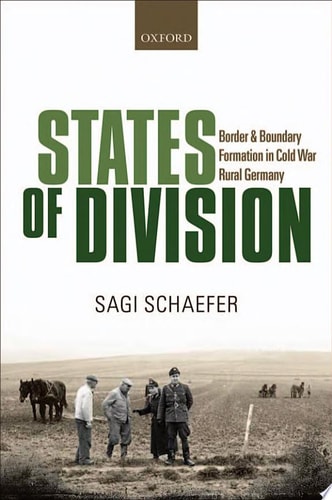
States of Division: Borders and Boundary Formation in Cold War Rural Germany
0
0
As an Amazon Associate and affiliate partner, Menrva Books earns from qualifying purchases. Learn more
Author Description
States of Division analyses the division of Germany and the development of the Iron Curtain during the four and a half decades of the Cold War. The centerpiece of this global fault-line was the thousand-mile-long border dividing Germany into West and East. This long border traversed primarily rural peripheries and the development of division along it entailed protracted processes of social and cultural demarcation. Unlike the Berlin Wall, which sprang up overnight in the urban enclave under watchful eyes of Soviet and Western armies, the inter-German border evolved slowly through interactions between frontier residents and various state agencies. The division of Germany and of the world emerged through conflicts between everyday practices, economic necessities, policies of German and foreign governments, and their ability to push these policies through.The division of Germany was a multi-faceted process, which progressed slowly and unevenly. States of Division demonstrates that along with the crucial context of the Cold War, multiple historical and social frameworks are required to decipher division and explain how and where it took place. Dividing a modern integrated society along a thousand-mile border was not planned or intended by the allies and at no stage was agreed upon by East and West German authorities. It gave rise to contradictions and conflicts with practice and tradition, undermining economy and culture in the borderlands, and required protracted negotiations and considerable resources. It was not a fait accompli of Yalta or Potsdam, nor was it completed with the construction of the Berlin Wall in 1961. German division only stabilized as a sociopolitical fact through the inter-German compromise of the 1970s, which also planted the seeds of its undoing. Integrating local, regional and national perspectives, this volume tells a complex story, showing how diplomacy and policy affected daily practices and were affected by them.
Menrva's Summary
THE THESIS
This book investigates how the division of Germany during the Cold War evolved not as a sudden geopolitical event, but as a protracted, uneven process of social and cultural demarcation within rural borderlands. Sagi Schaefer, a historian specializing in modern German history, utilizes archival research and regional case studies to challenge the narrative that the Iron Curtain was a static, top-down imposition. He argues that the border was shaped by the complex interplay between state-level diplomatic policies and the everyday economic and social practices of frontier residents, ultimately requiring decades of negotiation to stabilize.
THE SCOPE MAP
What You Will Find
- Analysis of the thousand-mile inter-German border as a site of social and cultural evolution.
- Examination of the interaction between local rural populations and state agencies during the Cold War.
- Historical evidence drawn from regional archives and government policy records.
- A framework for understanding how national division impacts integrated modern societies at the local level.
THE AUTHORITY PERSPECTIVE
Historians and scholars of European studies identify this work as a significant contribution to the understanding of the Cold War from a bottom-up perspective. Readers frequently note the academic density of the prose and the author's success in bridging the gap between high-level diplomacy and local history.
Page Count:
288
Publication Date:
2014-12-09
Publisher:
Oxford University Press
ISBN-10:
0199672385
ISBN-13:
9780199672387
History
Sociology
European History
German history
Cold War
National Characteristics German
Politics & Government
Community Tags
Similar Books