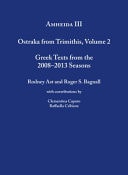
Amheida III Ostraka from Trimithis, Volume 2
0
0
As an Amazon Associate and affiliate partner, Menrva Books earns from qualifying purchases. Learn more
Author Description
This archaeological report provides a comprehensive study of the excavations carried out at Amheida House B2 in Egypt's Dakhleh Oasis between 2005 and 2007, followed by three study seasons between 2008 and 2010. The excavations at Amheida in Egypt's western desert, begun in 2001 under the aegis of Columbia University and sponsored by NYU since 2008, are investigating all aspects of social life and material culture at the administrative center of ancient Trimithis. The excavations so far have focused on three areas of this very large site: a centrally located upper-class fourth-century AD house with wall paintings, an adjoining school, and underlying remains of a Roman bath complex; a more modest house of the third century; and the temple hill, with remains of the Temple of Thoth built in the first century AD and of earlier structures. Architectural conservation has protected and partly restored two standing funerary monuments, a mud-brick pyramid and a tower tomb, both of the Roman period. This is the second volume of ostraka from the excavations Amheida (ancient Trimithis) in Egypt. It adds 491 items to the growing corpus of primary texts from the site. In addition to the catalog, the introductory sections make important contributions to understanding the role of textual practice in the life of a pre-modern small town. Issues addressed include tenancy, the administration of water, governance, the identification of individuals in the archaeological record, the management of estates, personal handwriting, and the uses of personal names. Additionally, the chapter "Ceramic Fabrics and Shapes" by Clementina Caputo breaks new ground in the treatment of these inscribed shards as both written text and physical object. This volume will be of interest to specialists in Roman-period Egypt as well as to scholars of literacy and writing in the ancient world and elsewhere.
Menrva's Summary
THE THESIS
This volume presents a detailed analysis of 491 ostraca discovered at the ancient Egyptian site of Trimithis, contributing significantly to the understanding of textual practices in a pre-modern small town. The book is the second in a series of ostraka studies from the Amheida excavations, building upon previous work at the site which began in 2001. The authors, including leading archaeologists and epigraphers, utilize these inscribed pottery shards as primary source material to investigate various facets of daily life. The research addresses critical aspects such as land tenancy, water administration, governance, personal identification within the archaeological record, estate management, handwriting analysis, and the usage of personal names in Roman-period Egypt.
THE SCOPE MAP
- Catalog of 491 ostraca from Amheida (ancient Trimithis), Egypt.
- Analysis of tenancy, water administration, and governance in a pre-modern town.
- Studies on the identification of individuals in the archaeological record and estate management.
- Examination of personal handwriting and the use of personal names.
- A chapter on "Ceramic Fabrics and Shapes" by Clementina Caputo, treating inscribed shards as both text and object.
- Contributions to understanding literacy and writing in the ancient world.
THE AUTHORITY PERSPECTIVE
This volume is recognized as a significant contribution to the study of Roman-period Egypt and ancient literacy, offering a substantial corpus of primary texts. Specialists in the field will find the detailed catalog and the analytical chapters invaluable for understanding the social and administrative life of Trimithis. The interdisciplinary approach, combining epigraphy with ceramic analysis, provides a nuanced perspective on the material and textual evidence from the site.
Page Count:
15
Publication Date:
2016-01-01
Publisher:
New York University Press
ISBN-10:
1479801739
ISBN-13:
9781479801732
Non-Fiction
History
Ancient History
Roman History
Egyptology
Archaeology
Epigraphy
Community Tags
Similar Books






Reader Comments
Share Your Thoughts
No comments yet. Be the first to share your thoughts!