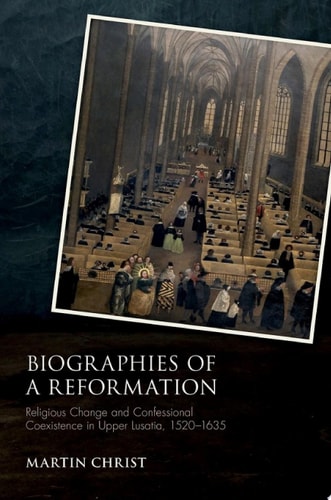
Biographies of a Reformation: Religious Change and Confessional Coexistence in Upper Lusatia, 1520-1635
0
0
As an Amazon Associate and affiliate partner, Menrva Books earns from qualifying purchases. Learn more
Author Description
Biographies of a Reformation: Religious Change and Confessional Coexistence in Upper Lusatia, c. 1520-1635 investigates how religious coexistence functioned in six towns in the multiconfessional region of Upper Lusatia in Western Bohemia. Lutherans and Catholics found a feasible modus vivendi through written agreements and regular negotiations. This meant that the Habsburg kings of Bohemia ruled over a Lutheran region. Lutherans and Catholics in Upper Lusatia shared spaces, objects, and rituals. Catholics adopted elements previously seen as a firm part of a Lutheran confessional culture. Lutherans, too, were willing to incorporate Catholic elements into their religiosity. Some of these overlaps were subconscious, while others were a conscious choice. This book provides a new narrative of the Reformation and shows that the concept of the 'urban Reformation', where towns are seen as centres of Lutheranism has to be reassessed, particularly in towns in former East Germany, where much work remains to be done. It shows that in a region like Upper Lusatia, which did not have a political centre and underwent a complex Reformation with many different actors, there was no clear confessionalization. By approaching the Upper Lusatian Reformation through important individuals, Martin Christ shows how they had to negotiate their religiosity, resulting in cross-confessional exchange and syncretism.
Menrva's Summary
THE THESIS
How did religious coexistence function in the multiconfessional region of Upper Lusatia between 1520 and 1635? Martin Christ examines the Reformation through the lens of individual biographies to challenge traditional narratives of confessionalization. By analyzing the interactions between Lutherans and Catholics in six specific towns, the author argues that religious identity was often fluid and negotiated rather than strictly defined by institutional boundaries. The study utilizes archival records and biographical data to demonstrate how shared spaces and rituals fostered a unique environment of syncretism under Habsburg rule.
THE SCOPE MAP
What You Will Find
- Analysis of religious coexistence in six Upper Lusatian towns
- Examination of cross-confessional exchange through shared objects and rituals
- Biographical case studies of key individuals navigating religious identity
- Evaluation of the 'urban Reformation' model in the context of East German historiography
Scope Limits
- The study is geographically restricted to Upper Lusatia and does not provide a comprehensive overview of the entire Holy Roman Empire
- The research focuses primarily on the period between 1520 and 1635, excluding later developments in the region
THE AUTHORITY PERSPECTIVE
Scholars recognize this work as a significant contribution to the study of early modern religious history and the nuances of confessional coexistence. Readers frequently note the academic density of the prose, which is well-suited for researchers and students of Reformation history.
Page Count:
275
Publication Date:
2021-01-01
Publisher:
OUP Oxford
ISBN-10:
019263853X
ISBN-13:
9780192638533
History
Reformation
German history
History - Modern
European History