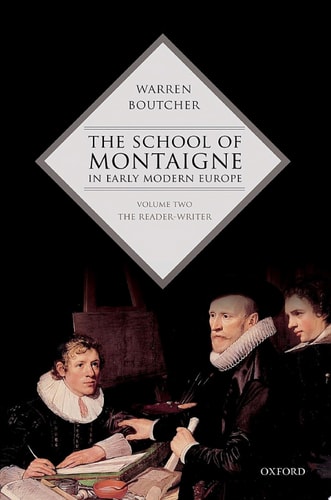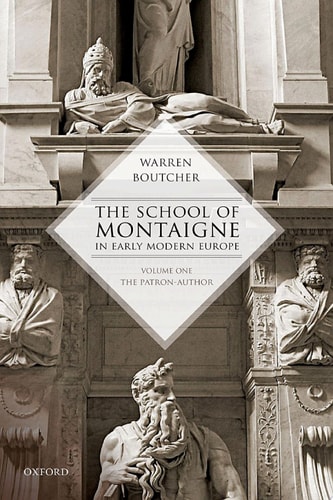
The School of Montaigne in Early Modern Europe: Volume One: The Patron Author
0
0
As an Amazon Associate and affiliate partner, Menrva Books earns from qualifying purchases. Learn more
Author Description
This major two-volume study offers an interdisciplinary analysis of Montaigne's Essais and their fortunes in early modern Europe and the modern western university. Volume one focuses on contexts from within Montaigne's own milieu, and on the ways in which his book made him a patron-author or instant classic in the eyes of his editor Marie de Gournay and his promoter Justus Lipsius. Volume two focuses on the reader-writers across Europe who used the Essais to make their own works, from corrected editions and translations in print, to life-writing and personal records in manuscript. The two volumes work together to offer a new picture of the book's significance in literary and intellectual history. Montaigne's is now usually understood to be the school of late humanism or of Pyrrhonian scepticism. This study argues that the school of Montaigne potentially included everyone in early modern Europe with occasion and means to read and write for themselves and for their friends and family, unconstrained by an official function or scholastic institution. For the Essais were shaped by a battle that had intensified since the Reformation and that would continue through to the pre-Enlightenment period. It was a battle to regulate the educated individual's judgement in reading and acting upon the two books bequeathed by God to man. The book of scriptures and the book of nature were becoming more accessible through print and manuscript cultures. But at the same time that access was being mediated more intensively by teachers such as clerics and humanists, by censors and institutions, by learned authors of past and present, and by commentaries and glosses upon those authors. Montaigne enfranchised the unofficial reader-writer with liberties of judgement offered and taken in the specific historical conditions of his era. The study draws on new ways of approaching literary history through the history of the book and of reading. The Essais are treated as a mobile, transnational work
Menrva's Summary
THE THESIS
This study investigates how Michel de Montaigne's Essais functioned as a catalyst for the development of the independent reader-writer in early modern Europe. Warren Boutcher, a specialist in Renaissance literature and intellectual history, utilizes extensive archival research and book history methodologies to argue that Montaigne provided a framework for personal judgment that bypassed traditional scholastic and ecclesiastical mediation. By examining the reception of the Essais through figures like Marie de Gournay and Justus Lipsius, the author demonstrates how the text transformed into a foundational tool for intellectual autonomy during the Reformation and pre-Enlightenment periods.
THE SCOPE MAP
What You Will Find
- Analysis of the editorial and promotional roles of Marie de Gournay and Justus Lipsius.
- Examination of the transition from scholastic institutional control to individual reading practices.
- Investigation into the impact of print and manuscript culture on the dissemination of the Essais.
- Exploration of the tension between religious/institutional censorship and the liberties of the private reader.
Scope Limits
- This volume focuses primarily on the early contexts of the work's creation and its immediate reception by key associates.
- The study does not provide a comprehensive biography of Montaigne himself, but rather focuses on the life and influence of his written work.
THE AUTHORITY PERSPECTIVE
Scholars recognize this work as a significant contribution to the history of the book and the study of late humanism. Readers frequently note the academic density of the prose, which is intended for specialists in early modern intellectual history and literary theory.
Page Count:
458
Publication Date:
2017-01-01
Publisher:
OUP Oxford
ISBN-10:
019106601X
ISBN-13:
9780191066016
Philosophy
Intellectual History
Book History
English & College Success
English
History - Modern
Literary Criticism
Community Tags
Similar Books