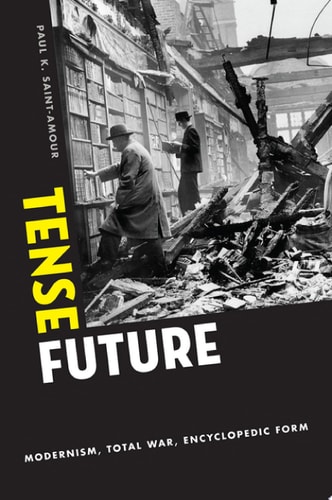
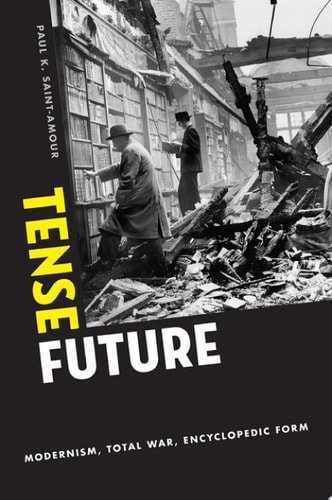
Tense Future: Modernism, Total War, Encyclopedic Form
0
0
As an Amazon Associate and affiliate partner, Menrva Books earns from qualifying purchases. Learn more
Author Description
We know that trauma can leave syndromes in its wake. But can the anticipation of violence be a form of violence as well? Tense Future argues that it can-that twentieth-century war technologies and practices, particularly the aerial bombing of population centers, introduced non-combatants to a coercive and traumatizing expectation. During wartime, civilians braced for the next raid; during peacetime they braced for the next war. The pre-traumatic stress they experienced permeates the century's public debates and cultural works. In a series of groundbreaking readings, Saint-Amour illustrates how air war prophets theorized the wounding power of anticipation, how archive theory changed course in war's shadow, and how speculative fiction conjured visions of a civilizational collapse that would end literacy itself. And in this book's central chapters, he shows us how Ford Madox Ford, Robert Musil, James Joyce, Virginia Woolf, and other interwar modernist writers faced the memory of one war and the prospect of another, some by pitting their fictions' encyclopedic scale and formal turbulence against total war, others by conceding war's inevitability while refusing to long for a politically regressive peace.Total war: a conflict that exempts no one, disregarding any difference between soldier and civilian. Tense Future forever alters our understanding of the concept of total war by tracing its emergence during the First World War, its incubation in air power theory between the wars, and above all its profound partiality. For total war, during most of the twentieth century, meant conflict between imperial nation states; it did not include the violence those states routinely visited on colonial subjects during peacetime. Tacking back and forth between metropole and colony, between world war and police action, Saint-Amour describes the interwar refashioning of a world system of violence-production, one that remains largely intact in our own moment of perpetual interwar.
Menrva's Summary
THE THESIS
This book investigates whether the anticipation of violence, specifically through the lens of twentieth-century aerial warfare, functions as a distinct form of trauma that shapes both public discourse and cultural production. Paul K. Saint-Amour, a scholar of modernist literature and war, utilizes a framework of 'pre-traumatic stress' to analyze how civilians and writers navigated the constant expectation of conflict. By examining the intersection of imperial power, colonial violence, and literary form, the author argues that the concept of 'total war' was a selective construct that ignored systemic violence against colonial subjects.
THE SCOPE MAP
What You Will Find
- Analysis of interwar modernist literature including works by Ford Madox Ford, Robert Musil, James Joyce, and Virginia Woolf.
- Examination of air power theory and its influence on civilian psychology.
- A critique of the historical definition of total war and its exclusion of colonial police actions.
- Theoretical exploration of archive theory and speculative fiction in the shadow of potential civilizational collapse.
Scope Limits
- The text does not provide a comprehensive military history of twentieth-century conflicts.
- It does not focus on post-1945 developments in warfare technology or contemporary counter-terrorism strategies.
THE AUTHORITY PERSPECTIVE
Scholars frequently cite this work as a significant contribution to modernist studies and the critical understanding of war's cultural impact. Readers often note the academic density of the prose, which requires a strong background in literary theory and historical context to fully navigate.
Page Count:
368
Publication Date:
2015-03-02
Publisher:
Oxford University Press
ISBN-10:
0190200944
ISBN-13:
9780190200947
Political Theory
Cultural History
Literary Criticism
Modernism
War Studies
Community Tags
Other Editions(2)
Similar Books





Reader Comments
Share Your Thoughts
No comments yet. Be the first to share your thoughts!