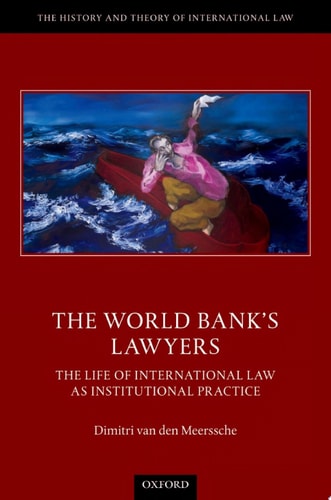
The World Bank's Lawyers: The Life of International Law as Institutional Practice
0
0
As an Amazon Associate and affiliate partner, Menrva Books earns from qualifying purchases. Learn more
Author Description
The World Bank's Lawyers provides an original socio-legal account of the evolving institutional life of international law. Informed by oral archives, months of participant observation, interviews, legal memoranda, and documents obtained through freedom-of-information requests, it tells a previously untold story of the World Bank's legal department between 1983 and 2016. This is a story of people and the beliefs they have, the influence they seek, and the tools they employ. It is an account of the practices they cling to and how these practices gain traction, or how they fail to do so, in an international bureaucracy. Inspired by actor-network theory, relational sociologies of association, and performativity theory, this ethnographic exploration multiplies the matters of concern in our study of international law (and lawyering): the human and non-human, material and semantic, visible and evasive actants that tie together the fragile fabric of legality. In tracing these threads, this book signals important changes in the conceptual repertoire and materiality of international legal practice, as liberal ideals were gradually displaced by managerial modes of evaluation. It reveals a world teeming with life—a space where professional postures and prototypes, aesthetic styles, and technical routines are woven together in law's shifting mode of existence. This history of international law as a contingent cultural technique enriches our understanding of the discipline's disenchantment and the displacement of its traditional tropes by unexpected and unruly actors. It thereby inspires new ways of critical thinking about international law's political pathways, promises, and pathologies, as its language is inscribed in ever-evolving rationalities of rule.
Menrva's Summary
THE THESIS
This book investigates how international law functions as a lived, institutional practice within the World Bank by examining the shifting professional rationalities of its legal department. Dimitri Van Den Meerssche, a scholar of international law and socio-legal studies, utilizes an ethnographic framework to analyze the internal mechanics of the World Bank. By synthesizing archival research with participant observation, the author argues that liberal legal ideals have been increasingly supplanted by managerial and technical modes of evaluation over the period of 1983 to 2016.
THE SCOPE MAP
What You Will Find
- A detailed history of the World Bank's legal department from 1983 to 2016.
- Application of actor-network theory and performativity theory to legal practice.
- Analysis of professional postures, technical routines, and aesthetic styles within international bureaucracy.
Scope Limits
- The study focuses specifically on the World Bank and does not provide a comprehensive history of international law across all global institutions.
- It does not offer a normative prescription for how international law should be practiced, focusing instead on descriptive socio-legal analysis.
THE AUTHORITY PERSPECTIVE
Experts in international law and socio-legal studies recognize this work as a significant contribution to the ethnographic study of legal institutions. Readers frequently note the academic density of the prose, which requires familiarity with sociological theory to fully appreciate the author's methodological approach.
Page Count:
336
Publication Date:
2022-01-01
Publisher:
OUP Oxford
ISBN-10:
019266168X
ISBN-13:
9780192661685
International Law
Legal Theory
Professional Career & Trade
Bureaucracy
Institutional History
Sociology of Law
Community Tags
Similar Books