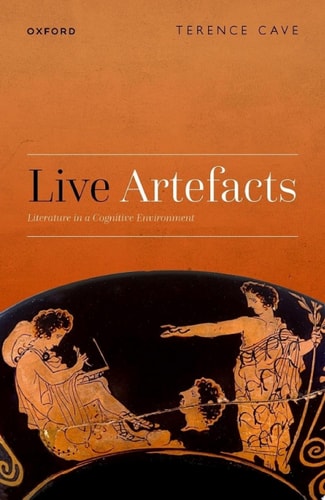
Live Artefacts: Literature in a Cognitive Environment
0
0
As an Amazon Associate and affiliate partner, Menrva Books earns from qualifying purchases. Learn more
Author Description
Literary artefacts--the stories people tell, the songs they sing, the scenes they enact--are neither a by-product nor a side-issue in human culture. They provide a model of everything that cognition does. They refuse to separate thought from emotion, bodily responses from ethical reflection, perception from imagination, logic from desire. Above all, they demonstrate the essential fluidity and mobility of human cognition, its adaptive inventiveness. If we are astonished by the art of Chauvet or Lascaux as an early model of human cognition, then we should be continually astonished by what literature is and does as it reaches beyond itself to reimagine the world. This book argues that literary artefacts are quasi-autonomous living entities, fashioned to animate captured environments, embodied people and other creatures, ways of being and living that remain virtual. They own a freely delegated agency that allows them to speak to listeners and readers present and distant, present and future, adapting themselves and their meanings to whatever cognitive environment they encounter. Such an approach offers a way of linking a close attention to the specific properties of literary artefacts with the insights of cognitive anthropology and archaeology, and thus of satisfying the conditions for a properly interdisciplinary understanding of literature. It aims both to defend literary study against utilitarian and reductive arguments of all kinds and to argue that literary artefacts may give us new insights into how the mind (and its indispensable substratum, the brain) functions in the human ecology.
Menrva's Summary
THE THESIS
This book investigates the core question of how literary artefacts function as active, quasi-autonomous entities that model and reflect the fluidity of human cognition. Terence Cave, a scholar of literature and cognitive studies, utilizes a framework that bridges literary analysis with cognitive anthropology and archaeology. He argues that literature is not a passive cultural byproduct but an adaptive, inventive system that integrates emotion, bodily response, and ethical reflection to reimagine human experience.
THE SCOPE MAP
What You Will Find
- A theoretical framework treating literary works as living, adaptive cognitive entities.
- An interdisciplinary synthesis of literary theory, cognitive science, and archaeology.
- Arguments regarding the agency of texts in communicating across temporal and cultural distances.
Scope Limits
- The text does not provide a comprehensive history of literature or a survey of specific literary movements.
- It does not offer a technical neurological study of brain function, focusing instead on the cognitive ecology of literary reception.
THE AUTHORITY PERSPECTIVE
Scholars and critics recognize this work as a significant contribution to the cognitive turn in literary studies, noting its dense, philosophical prose. Experts highlight the text as a rigorous defense of literary study that successfully integrates disparate fields of inquiry.
Page Count:
264
Publication Date:
2022-01-01
Publisher:
OUP Oxford
ISBN-10:
019267384X
ISBN-13:
9780192673848
Literary Criticism
Philosophy of
Cognitive Anthropology
Interdisciplinary Studies
English
English & College Success
Community Tags
Similar Books