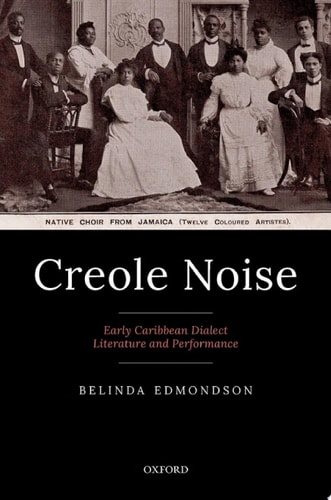
Creole Noise: Early Caribbean Dialect Literature and Performance
0
0
As an Amazon Associate and affiliate partner, Menrva Books earns from qualifying purchases. Learn more
Author Description
Creole Noise is a history of Creole, or 'dialect', literature and performance in the English-speaking Caribbean, from the late eighteenth century to the early twentieth century. By emphasizing multiracial origins, transnational influences, and musical performance alongside often violent historical events of the nineteenth century - slavery, Emancipation, the Morant Bay Rebellion, the era of blackface minstrelsy, indentureship and immigration - it revises the common view that literary dialect in the Caribbean was a relatively modern, twentieth-century phenomenon, associated with regional anti-colonial or black-affirming nationalist projects. It explores both the lives and the literary texts of a number of early progenitors, among these a number of pro-slavery white creoles as well as the first black author of literary dialect in the English-speaking Caribbean. Creole Noise features a number of fascinating historical characters, among these Henry Garland Murray, a black Jamaican journalist and lecturer; Michael McTurk, the white magistrate from British Guiana who, as 'Quow', authored one of the earliest books of dialect literature; as well as blackface comedian and calypsonian Sam Manning, who along with Marcus Garvey's ex-wife, Amy Ashwood Garvey, wrote a popular dialect play that traveled across the United States. In so doing it reconstructs an earlier period of dialect literature, usually isolated or dismissed from the cultural narrative as racist mimicry or merely political, not part of a continuum of artistic production in the Caribbean
Menrva's Summary
THE THESIS
This work investigates the origins and evolution of Creole dialect literature and performance in the English-speaking Caribbean, challenging the assumption that such works are exclusively a twentieth-century nationalist phenomenon. Belinda Edmondson, a scholar specializing in Caribbean literature and culture, utilizes historical archives and literary analysis to demonstrate that dialect writing has deep roots in the eighteenth and nineteenth centuries. By examining a diverse range of authors—including white creoles and early black writers—the book argues that these texts are integral to a broader, complex continuum of Caribbean artistic production rather than isolated incidents of mimicry or political propaganda.
THE SCOPE MAP
What You Will Find
- Historical analysis of dialect literature from the late eighteenth century to the early twentieth century.
- Examination of the intersection between literary production and major events like the Morant Bay Rebellion and the era of blackface minstrelsy.
- Biographical studies of figures such as Henry Garland Murray, Michael McTurk, and Sam Manning.
- Exploration of the transnational influences and multiracial origins of Caribbean performance culture.
Scope Limits
- The study focuses specifically on the English-speaking Caribbean and does not provide an exhaustive survey of French or Spanish-speaking Caribbean dialect traditions.
- The analysis prioritizes early progenitors and does not aim to provide a comprehensive history of twentieth-century post-colonial literature.
THE AUTHORITY PERSPECTIVE
Scholars and historians recognize this text as a significant intervention in Caribbean literary studies for its archival recovery of overlooked early dialect writers. Experts frequently note that the book successfully complicates the traditional narrative surrounding the development of regional identity and artistic expression in the Caribbean.
Page Count:
204
Publication Date:
2021-01-01
Publisher:
OUP Oxford
ISBN-10:
0192670824
ISBN-13:
9780192670823
History
English
Cultural History
English & College Success
American History
Caribbean Studies
Literary Criticism
Linguistics
Community Tags
Similar Books