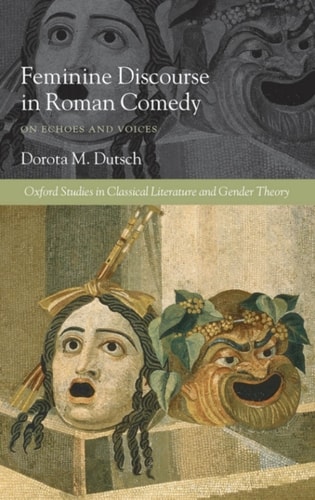
Feminine Discourse in Roman Comedy: On Echoes and Voices
0
0
As an Amazon Associate and affiliate partner, Menrva Books earns from qualifying purchases. Learn more
Author Description
As literature written in Latin has almost no female authors, we are dependent on male writers for some understanding of the way women would have spoken. Plautus (3rd to 2nd century BCE) and Terence (2nd century BCE) consistently write particular linguistic features into the lines spoken by their female characters: endearments, soft speech, and incoherent focus on numerous small problems. Dorota M. Dutsch describes the construction of this feminine idiom and asks whether it should be considered as evidence of how Roman women actually spoke.
Menrva's Summary
THE THESIS
This work investigates whether the linguistic patterns assigned to female characters in Roman comedy reflect the actual speech of contemporary women or represent a constructed male perception of femininity. Dorota M. Dutsch, a scholar of classical literature, analyzes the dramatic texts of Plautus and Terence to deconstruct the specific rhetorical devices and speech habits attributed to women. By examining the intersection of gender, performance, and language, the author argues that these portrayals serve as a deliberate literary device rather than a historical record of Roman female vernacular.
THE SCOPE MAP
What You Will Find
- Linguistic analysis of endearments and soft speech patterns in Roman comedy
- Comparative study of Plautus and Terence
- Theoretical framework regarding gendered speech construction in antiquity
Scope Limits
- Does not provide a comprehensive history of Roman women's daily lives
- Does not analyze non-dramatic Latin texts or epigraphic evidence
THE AUTHORITY PERSPECTIVE
Experts recognize this text as a significant contribution to the study of gender in classical literature, noting its rigorous approach to linguistic characterization. Readers frequently highlight the academic density of the prose, which is intended for scholars and advanced students of classical studies.
Page Count:
320
Publication Date:
2008-01-01
Publisher:
Oxford University Press
ISBN-10:
0191559865
ISBN-13:
9780191559860
History
Gender Theory
Linguistics
Literary Criticism
In literature
Criticism history
English
English & College Success
Roman
Community Tags
Similar Books