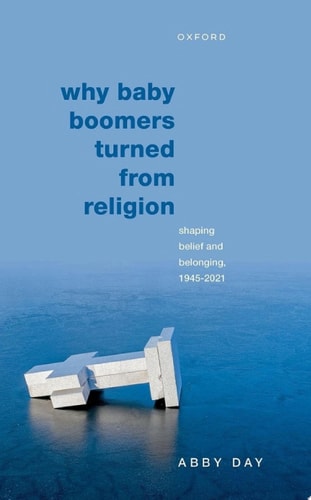
Why Baby Boomers Turned from Religion: Shaping Belief and Belonging, 1945-2021
0
0
As an Amazon Associate and affiliate partner, Menrva Books earns from qualifying purchases. Learn more
Author Description
Mocked, vilified, blamed, and significantly misunderstood - the 'Baby Boomers' are members of the generation of post-WWII babies who came of age in the 1960s. Parents of the 1940s and 1950s raised their Boomer children to be respectable church-attendees, and yet in some ways demonstrated an ambivalence that permitted their children to spurn religion and eventually to raise their own children to be the least religious generation ever. The Baby Boomers studied here, living in the UK and Canada, were the last generation to have been routinely baptised and taken regularly to mainstream, Anglican churches. So, what went wrong - or, perhaps, right? This study, based on in-depth interviews and compared to other studies and data, is the first to offer a sociological account of the sudden transition from religious parents to non-religious children and grandchildren, focusing exclusively on this generation of ex-Anglican Boomers. Now in their 60s and 70s, the Boomers featured here make sense of their lives and the world they helped create. They discuss how they continue to dis-believe in God yet have an easy relationship with ghosts, and how they did not, as theologians often claim, fall into an immoral self-centred abyss. They forged different practices and sites (whether in 'this world' or 'elsewhere') of meaning, morality, community, and transcendence. They also reveal here the values, practices, and beliefs they transmitted to the future generations, helping shape the non-religious identities of Generation X, Millennials, and Generation Z.
Menrva's Summary
THE THESIS
This study investigates the sociological factors behind the generational shift that led Baby Boomers to abandon traditional religious institutions in favor of secular or alternative belief systems. Abby Day, a professor of sociology of religion, utilizes qualitative interview data and comparative sociological research to examine the transition from religious upbringing to non-religious adulthood. The work argues that this shift does not represent a descent into moral decay, but rather a reconfiguration of meaning, morality, and transcendence outside of established church structures.
THE SCOPE MAP
What You Will Find
- Sociological analysis of the transition from Anglicanism to secularism in the UK and Canada.
- Qualitative data derived from in-depth interviews with Baby Boomers in their 60s and 70s.
- Examination of how non-religious values are transmitted to Generation X, Millennials, and Generation Z.
Scope Limits
- The study focuses exclusively on ex-Anglican Boomers in the UK and Canada, excluding other denominations or geographic regions.
- The research does not provide a theological critique of religious decline, focusing instead on the sociological lived experience of the participants.
THE AUTHORITY PERSPECTIVE
Scholars in the sociology of religion recognize this text as a significant contribution to understanding the decline of mainstream church attendance in the West. Readers frequently note the academic rigor of the qualitative methodology and the clarity with which the author addresses the complex intersection of generational identity and belief.
Page Count:
243
Publication Date:
2022-01-01
Publisher:
OUP Oxford
ISBN-10:
0192691961
ISBN-13:
9780192691965
History
Religion
Secularism
Sociology
Baby Boomers
Community Tags
Similar Books