Two Arguments for the Identity of Indiscernibles
0
0
As an Amazon Associate and affiliate partner, Menrva Books earns from qualifying purchases. Learn more
Author Description
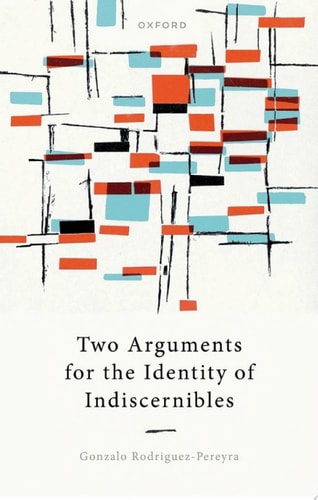
The Principle of Identity of Indiscernibles is the thesis that, necessarily, no two (concrete) objects differ only numerically. This is the weakest version of the Principle of Identity of Indiscernibles. Gonzalo Rodriguez-Pereyra argues that there is no trivial version of the Principle of Identity of Indiscernibles, since what is usually known as the trivial version of the principle is consistent with objects differing only numerically. He provides two positive arguments for the Principle: one based on broadly Humean considerations excluding a certain kind of necessary connection between distinct objects, and the other based on ideas about what grounds the having of certain properties by objects. This book also presents two new arguments against restricted versions of the principle according to which, necessarily, no two objects can be purely qualitatively indiscernible or intrinsically purely qualitatively indiscernible. It is further argued that one of the arguments for the weakest version of the principle can be extended to abstract objects. The conclusion is drawn that, necessarily, there are no objects, whether abstract or concrete, that differ only numerically.
Menrva's Summary
THE THESIS
This book investigates the validity and implications of the Principle of Identity of Indiscernibles, specifically questioning whether objects can exist that differ only numerically. Gonzalo Rodriguez-Pereyra, a scholar in metaphysics, evaluates the logical consistency of various versions of the principle. He challenges the notion of a trivial version and constructs a rigorous framework to support the claim that no two objects, whether concrete or abstract, can be purely numerically distinct.
THE SCOPE MAP
What You Will Find
- Analysis of the weakest version of the Principle of Identity of Indiscernibles
- Arguments derived from Humean considerations regarding necessary connections
- Theoretical exploration of property grounding
- Extensions of the principle to abstract objects
Scope Limits
- Does not provide a comprehensive history of the principle from Leibniz to the present
- Excludes non-analytic or continental philosophical perspectives on identity
THE AUTHORITY PERSPECTIVE
Philosophers and students of metaphysics frequently cite this work as a significant contribution to contemporary debates on numerical identity. Experts highlight the text for its technical rigor and its systematic approach to dismantling common assumptions regarding the triviality of the principle.
Page Count:
142
Publication Date:
2022-01-01
Publisher:
OUP Oxford
ISBN-10:
0192692348
ISBN-13:
9780192692344
Philosophy
Logic
Ontology
Knowledge Theory
Metaphysics
Mathematics Statistics
Mathematics - General