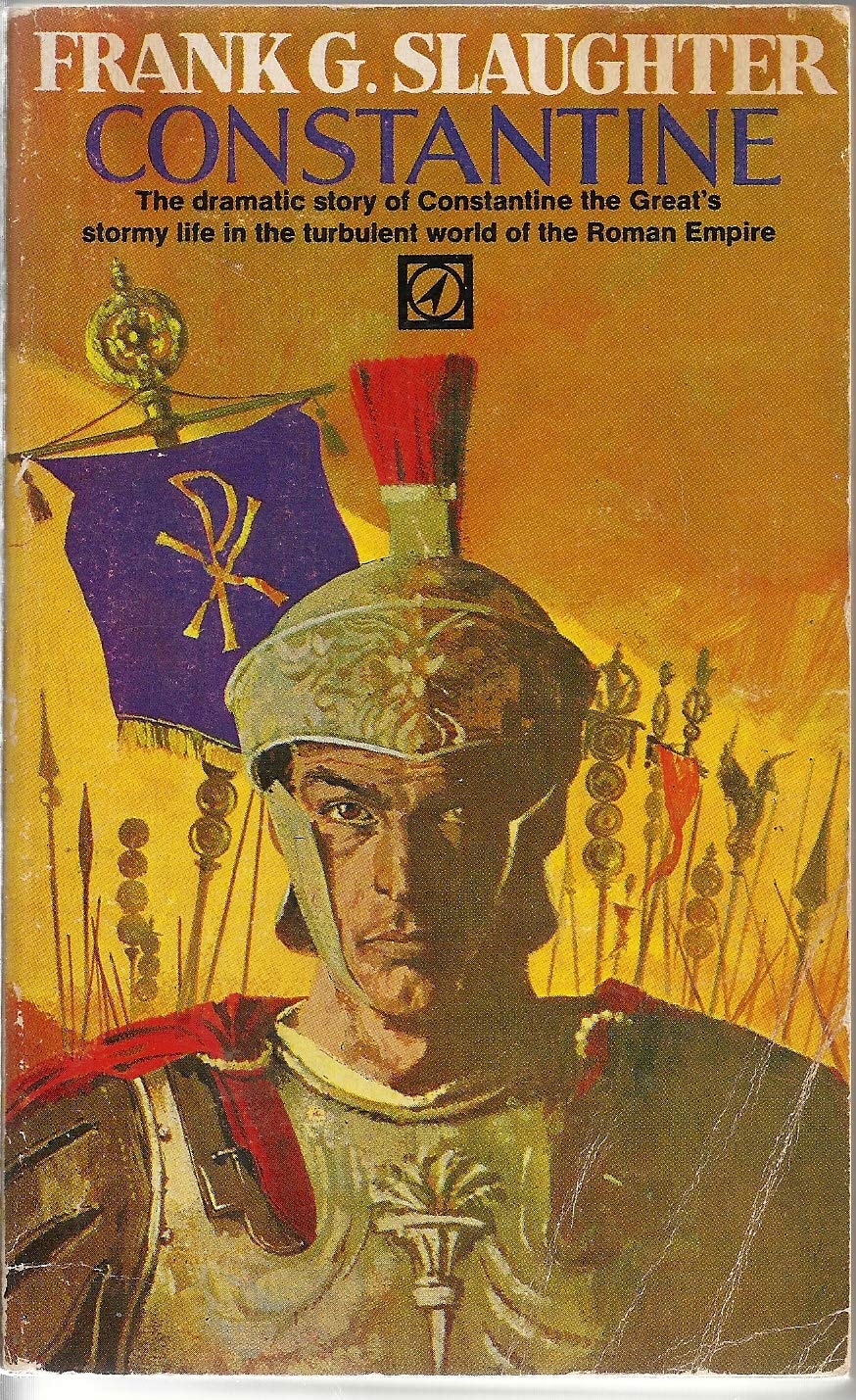
Constantine : The Miracle of the Flaming Cross
0
0
As an Amazon Associate and affiliate partner, Menrva Books earns from qualifying purchases. Learn more
Author Description
Constantine the Great was a leader and victor in many campaigns, but one battle stood above all others-- the battle against Maxentius, when Constantine saw a fiery cross in the sky, and thence-forth took as his "In this sign conquer." This mystic revelation, as reported by Eusebius and other contemporaries, led to Constantine's acceptance and then devoted use of Christianity to consolidate his Empire. In ' The Miracle of the Flaming Cross', Frank G. Slaughter has re-created all the moving and colorful events of Constantine's life, in the turbulent Roman world of the 3rd and 4th centuries..."At this crucial point in the history of Christianity, a Roman Emperor arose who gave paganism the death blow. He was Constantine the Great..." At first giving Christianity equal status with paganism, Constantine was able -- for a time -- to constrain not only rebellious military rivals but also the Christian bishops who were fighting among themselves, and at Nicaea he established what was probably the first ecumenical council.
Menrva's Summary
THE PULSE
The narrative centers on the pivotal transformation of Constantine the Great as he navigates the violent political landscape of the Roman Empire and experiences a vision that alters the course of Western history. The protagonist seeks to unify a fractured empire while contending with military rivals and internal religious discord. His objective is to stabilize Roman authority, a goal constantly challenged by the shifting loyalties of his generals and the theological disputes among early Christian leaders. The narrative follows a traditional third-person historical framework, detailing the transition from pagan dominance to the rise of Christianity.
INSIDE THE PAGES
- Detailed accounts of 3rd and 4th-century Roman military campaigns
- Dramatization of the Battle of the Milvian Bridge
- Exploration of the political maneuvering between Constantine and Maxentius
- Depiction of the Council of Nicaea and early ecclesiastical conflicts
- Character study of Constantine's evolution from pagan leader to Christian patron
- Integration of historical accounts from Eusebius and other contemporaries
- Atmospheric reconstruction of the Roman imperial court
- Focus on the intersection of personal ambition and religious institutionalization
THE COLLECTIVE ECHO
Readers often note that the work functions as a dramatized biography, prioritizing the political and religious shifts of the era over intimate character interiority. Discussion frequently centers on the author's ability to synthesize complex historical events into a readable narrative format. Critics highlight the balance between the depiction of military strategy and the theological debates that defined the period. Many readers appreciate the focus on the Council of Nicaea as a central conflict point, providing context for the consolidation of imperial power. The prose is generally described as accessible, aiming to make the transition of the Roman Empire understandable for a general audience.
Page Count:
384
Publication Date:
1968-01-01
Publisher:
Arrow Books
ISBN-10:
0090008901
ISBN-13:
9780090008902
Historical Fiction
Ancient - Rome
Biographical fiction
Christian History
Community Tags
Similar Books