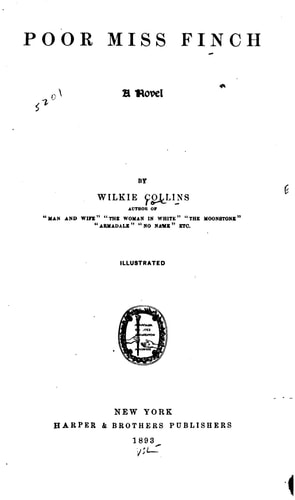
Poor Miss Finch
0
0
As an Amazon Associate and affiliate partner, Menrva Books earns from qualifying purchases. Learn more
Author Description
Wilkie Collins's intriguing story about a blind girl, Lucilla Finch, and the identical twins who both fall in love with her, has the exciting complications of his better-known novels but it also overturns conventional expectations. Using a background of myth and fairy-tale to expand the boundaries of nineteenth-century realist fiction, Collins gives one of the best accounts in fiction of blindness and its implications.
Menrva's Summary
THE PULSE
The arrival of identical twin brothers into the life of a blind woman, Lucilla Finch, initiates a complex web of deception and romantic rivalry. Lucilla Finch, a young woman who has been blind since childhood, finds her life altered when she meets Oscar Dubourg, a man she believes to be her ideal partner. However, the narrative complicates this connection through the presence of Oscar's twin brother, Nugent, whose physical similarity to Oscar creates a series of ethical and romantic dilemmas. The story unfolds through a multi-perspective framework that examines the limitations of perception and the social constraints placed upon individuals with disabilities in the nineteenth century.
INSIDE THE PAGES
- Exploration of sensory perception and the experience of blindness
- Use of identical twins as a catalyst for identity confusion
- Incorporation of mythic and fairy-tale archetypes within a realist setting
- Multi-perspective narrative structure
- Examination of Victorian social norms and expectations
- Focus on moral ambiguity and the nature of deception
- Detailed character studies regarding internal motivations
- Integration of suspense elements typical of sensation fiction
THE COLLECTIVE ECHO
Readers and critics often note that this work occupies a unique space within the author's bibliography by blending traditional sensation tropes with a more psychological focus. Discussion frequently centers on the effectiveness of the portrayal of Lucilla's blindness, which is often praised for its nuance and departure from the period's typical sentimental tropes. Many readers highlight the tension generated by the identical twins, noting how the author uses this device to challenge the protagonist's autonomy and perception. The narrative pacing is frequently described as deliberate, allowing for a deep examination of the characters' moral choices rather than relying solely on plot-driven action.
Page Count:
480
Publication Date:
1995-09-14
Publisher:
Oxford University Press
ISBN-10:
0192823221
ISBN-13:
9780192823229
Mystery
Romance
England
Classic fiction
Realism
Victorian
Community Tags
Other Editions(22)

Independently Published
2021
Default edition
Independently Published
2021
CreateSpace Independent Publishing Platform
2018
CreateSpace Independent Publishing Platform
2018
CreateSpace Independent Publishing Platform
2017

CreateSpace Independent Publishing Platform
2017
Capital Communications, Incorporated
2017
CreateSpace Independent Publishing Platform
2017
CreateSpace Independent Publishing Platform
2015
ReadHowYouWant.com
2015

CreateSpace Independent Publishing Platform
2014

The Floating Press
2012

ReadHowYouWant.com
2011

ReadHowYouWant.com
2010
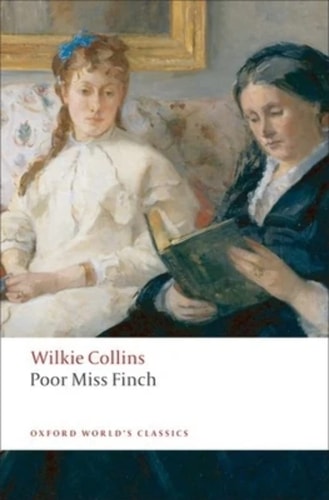
Oxford University Press
2009

ReadHowYouWant.com, Limited
2008

Chivers
2005

eBooksLib
2005

EBooksLib
2004

Classic Books
2001
Oxford University Press
1995
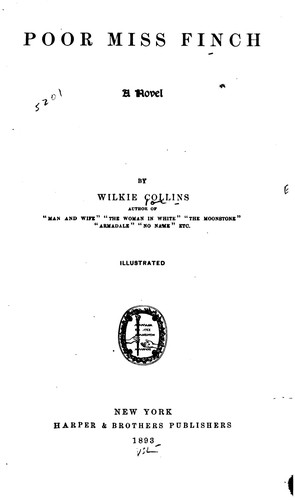
Oxford University Press
1995
Similar Books

Reader Comments
Share Your Thoughts
No comments yet. Be the first to share your thoughts!