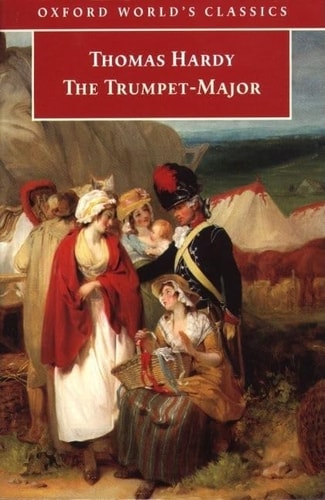
The Trumpet-Major
0
0
As an Amazon Associate and affiliate partner, Menrva Books earns from qualifying purchases. Learn more
Author Description
Hardy distrusted the application of nineteenth-century empiricism to history because he felt it marginalized important human elements. In The Trumpet Major, the tale of a woman courted by three competing suitors during the Napoleonic wars, he explores the subversive effects of ordinary human desire and conflicting loyalties on systematized versions of history. This edition restores Hardy's original punctuation and removes the bowdlerisms forced upon the text on its initial publication.
Menrva's Summary
THE PULSE
Anne Garland finds her quiet life in a coastal village disrupted by the arrival of three distinct suitors against the looming threat of a Napoleonic invasion. Anne Garland, a young woman of modest means, navigates the complex social and romantic pressures exerted by the Garland and Loveday families. She faces the persistent attentions of the reliable John Loveday, the ambitious Bob Loveday, and the refined Festus Derriman, each representing different facets of duty, passion, and status. The narrative, presented in a third-person omniscient voice, captures the tension between personal desire and the external demands of a nation preparing for war. The characters operate within the rigid social hierarchies of early nineteenth-century England, where the threat of French invasion serves as a constant, looming backdrop to their private conflicts.
INSIDE THE PAGES
- Third-person omniscient narration
- Historical setting during the Napoleonic Wars
- Exploration of social class and romantic rivalry
- Focus on the intersection of public history and private life
- Detailed depiction of rural English coastal life
- Use of irony to highlight character flaws
- Contrast between military duty and domestic stability
- Restoration of original punctuation and text integrity
THE COLLECTIVE ECHO
Readers and critics often note that this work occupies a unique space in the author's bibliography due to its lighter tone compared to his more somber later novels. Discussion frequently centers on the effectiveness of the historical setting, which serves as both a backdrop for romance and a commentary on the fragility of civilian life during wartime. Many observers highlight the nuanced characterization of the three suitors, noting how each represents a different archetype of masculine behavior in the nineteenth century. The pacing is frequently described as deliberate, allowing for a thorough examination of the social dynamics within the village. Overall, the text is recognized for its ability to balance domestic concerns with the broader, impersonal forces of national history.
Page Count:
416
Publication Date:
1999-07-22
Publisher:
Oxford University Press
ISBN-10:
0192836358
ISBN-13:
9780192836359
Romance
Classic Literature
Wessex England
Brothers fiction
Victorian
War
Historical
Community Tags
Other Editions(17)

Independently Published
2020
Default edition
Independently Published
2020

Independently Published
2020

Independently Published
2019

Independently Published
2019

Blurb, Incorporated
2019

Independently Published
2018

CreateSpace Independent Publishing Platform
2017
CreateSpace Independent Publishing Platform
2016

CreateSpace Independent Publishing Platform
2016

CreateSpace Independent Publishing Platform
2015

CreateSpace Independent Publishing Platform
2015

Hard Press
2006
Oxford University Press
1999

Adegi Graphics LLC
1999
Oxford University Press
1998
Oxford University Press
1991
Similar Books





Reader Comments
Share Your Thoughts
No comments yet. Be the first to share your thoughts!