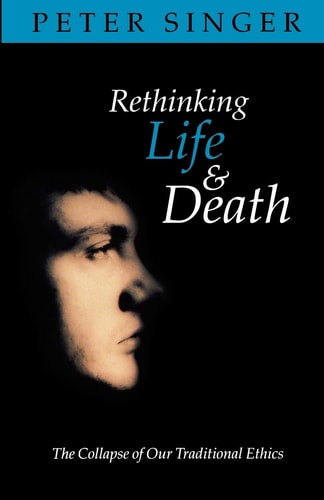
Rethinking Life and Death: The Collapse of Our Traditional Ethics
0
0
As an Amazon Associate and affiliate partner, Menrva Books earns from qualifying purchases. Learn more
Author Description
A victim of the Hillsborough Disaster in 1989, Anthony Bland lay in hospital in a coma being fed liquid food by a pump, via a tube passing through his nose and into his stomach. On 4 February 1993 Britain's highest court ruled that doctors attending him could lawfully act to end his life. Our traditional ways of thinking about life and death are collapsing. In a world of respirators and embryos stored for years in liquid nitrogen, we can no longer take the sanctity of human life as the cornerstone of our ethical outlook. In this controversial book Peter Singer argues that we cannot deal with the crucial issues of death, abortion, euthanasia and the rights of nonhuman animals unless we sweep away the old ethic and build something new in its place. Singer outlines a new set of commandments, based on compassion and commonsense, for the decisions everyone must make about life and death.
Menrva's Summary
THE THESIS
Can the traditional sanctity-of-life ethic remain viable in an era of advanced medical technology and shifting moral landscapes? Peter Singer, a prominent moral philosopher, examines the inadequacy of historical ethical frameworks when confronted with modern medical realities like persistent vegetative states, embryo storage, and euthanasia. He proposes a transition toward a new ethical paradigm rooted in quality-of-life assessments and rational compassion rather than the absolute preservation of biological life.
THE SCOPE MAP
What You Will Find
- Analysis of the legal and ethical implications of the Anthony Bland case
- Examination of the moral status of embryos and non-human animals
- A proposed set of new ethical commandments for modern decision-making
- Arguments regarding the distinction between killing and letting die
Scope Limits
- Does not provide a comprehensive legal guide for medical practitioners
- Focuses primarily on Western ethical traditions and secular moral philosophy
THE AUTHORITY PERSPECTIVE
Experts recognize this work as a significant contribution to the field of bioethics that challenges long-standing moral intuitions. Readers frequently note the provocative nature of the arguments, which often spark intense debate regarding the boundaries of human rights and medical intervention.
Page Count:
264
Publication Date:
1995-09-01
Publisher:
Oxford Univ Pr
ISBN-10:
0192861840
ISBN-13:
9780192861849
Non-Fiction
Philosophy
Medical Ethics
Sociology
Ethics
Bioethics