Rogue Sexuality in Early Modern English Literature: Desire, Status, Biopolitics
0
0
As an Amazon Associate and affiliate partner, Menrva Books earns from qualifying purchases. Learn more
Author Description
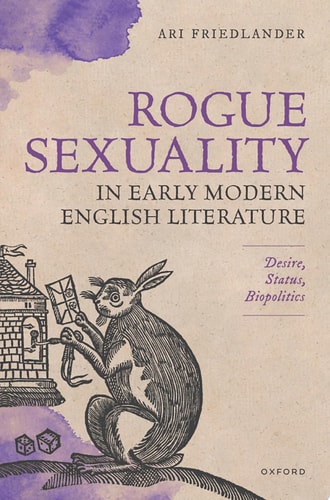
The "rogue," a term that described criminals, prostitutes, vagrants, beggars, and the unemployed, dominated the pages of early modern popular crime literature. Rogue Sexuality resituates the rogue by focusing on how their menace--and their seductive appeal--emerged not only from their social marginality, but also from their supposedly excessive sexuality and prodigious sexual reproduction.Through discussions of both familiar and little-studied early modern works by William Shakespeare, John Milton, Ben Jonson, Thomas Middleton, Thomas Dekker, Robert Greene, Thomas Harman, and the inventor of modern demography John Graunt, this volume posits the sexualized rogue as the avatar of a new category of "socio-sexual identity" and traces a surprising social transposition, in which socio-political elites are portrayed as appropriating the rogue's sexual vitality and performative charisma to navigate moments of crisis. By tracking the movement of rogue sexuality from a criminal to a normative discursive register, this book challenges the distinctions that literary critics and historians tend to draw between orderly and disorderly sexuality.With its focus on reproduction, rogue sexuality also provides a new framework for what Michel Foucault called "biopolitics," the state's focus on exercising power over life. In legal, administrative, and scientific documents, this book shows that early modern writers grappled with popular pamphlets' rendering of the alleged threat of rogue reproduction. Rogue Sexuality thus offers a new approach to the political history of early modern England as a population--as a people whose aggregate sexual life and reproduction were a key part of its political imagination.
Menrva's Summary
THE THESIS
This book investigates how the figure of the 'rogue' in early modern English literature functioned as a central site for the development of biopolitics and socio-sexual identity. Ari Friedlander, an academic specializing in early modern literature and culture, utilizes a diverse array of primary sources—ranging from popular crime pamphlets to canonical works by Shakespeare and Milton—to argue that the rogue's perceived sexual excess was not merely a marker of marginality, but a vital component of the era's political imagination. By analyzing the intersection of reproduction, criminality, and state power, the author demonstrates how elite classes appropriated rogue-like performative charisma to navigate political crises, thereby blurring the lines between normative and disorderly sexuality.
THE SCOPE MAP
What You Will Find
- Analysis of early modern crime literature and pamphlets alongside canonical texts by Shakespeare, Milton, Jonson, and others.
- A theoretical framework connecting Foucault's concept of biopolitics to early modern demographic concerns.
- Examination of the 'rogue' as a socio-sexual identity rather than a purely criminal category.
- Investigation into the role of reproduction in the political history of early modern England.
Scope Limits
- The study focuses primarily on English literature and administrative documents, excluding comparative analysis of continental European rogue literature.
- The analysis does not provide an exhaustive history of all criminal subcultures, focusing instead on the discursive construction of the rogue.
THE AUTHORITY PERSPECTIVE
Scholars in the field of early modern studies recognize this work as a significant contribution to the intersection of literary criticism and political history. Readers frequently note the academic density of the prose and the author's rigorous application of biopolitical theory to historical texts.
Page Count:
224
Publication Date:
2022-11-30
Publisher:
Oxford University Press
ISBN-10:
0192863177
ISBN-13:
9780192863171
History - Modern
Gender Studies
English literature
Sociology
Literary Criticism
Cultural History
Community Tags
Similar Books