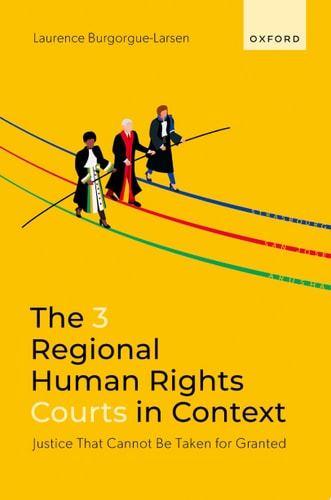
The 3 Regional Human Rights Courts in Context: Justice That Cannot Be Taken for Granted
0
0
As an Amazon Associate and affiliate partner, Menrva Books earns from qualifying purchases. Learn more
Author Description
At specific moments in the history of Africa, Europe, and Latin America, each region decided to create supranational jurisdictions to protect human rights. These are, in chronological order, the European Court of Human Rights, the Inter-American Court of Human Rights, and the African Court on Human and Peoples' Rights. While each has been the subject of important, dedicated monographs, no major study has analysed both the institutional and jurisprudential issues of all three regional systems.The 3 Regional Human Rights Courts in Context: Justice That Cannot Be Taken for Granted is the first book to offer a comprehensive comparison of the three systems. Rather than merely juxtaposing analogous features, the book considers how the three courtsoperate as parts of a greater, integrated whole. Similarities and differences between the courts are illuminated alongside historical, political, and sociological insights, in addition to the book's primary legal focus.Close analysis of the processes by which the courtscame into being makes it clear that, regardless of distinct political, cultural, or other variances, states on each of the three continents have chafed against international supervision. The book also debunks the common belief that, after the Second World War, the thrust of human rights initiatives was so powerful that states no longer need to discuss them. Justice cannot be taken for granted--a position further supported by the book's analysis of how each court has evolved and how their rulings have been implemented.Laurence Burgorgue-Larsen's dynamism and multidisciplinary approach makes it possible to truly understand the stakes behind the institutional and jurisprudential developments of the three regional human rights courts. This is a book that will interest not only legal practitioners but also specialists in international relations, human rights, and countless other fields.
Menrva's Summary
THE THESIS
This book investigates the institutional and jurisprudential evolution of the three major regional human rights courts to determine how they function as an integrated system of international protection. Laurence Burgorgue-Larsen, a scholar of international law, utilizes a multidisciplinary framework to examine the European Court of Human Rights, the Inter-American Court of Human Rights, and the African Court on Human and Peoples' Rights. By synthesizing legal analysis with historical and sociological context, the author argues that state resistance to international supervision remains a persistent challenge, refuting the notion that human rights protections are self-sustaining or universally accepted without ongoing political friction.
THE SCOPE MAP
What You Will Find
- Comparative analysis of the European, Inter-American, and African human rights systems
- Examination of the historical origins and political motivations behind the creation of each court
- Assessment of the implementation of rulings and the challenges of state compliance
- Multidisciplinary insights incorporating political and sociological perspectives
Scope Limits
- Does not provide an exhaustive case-by-case history of every individual ruling
- Excludes analysis of non-regional or domestic-only human rights mechanisms
THE AUTHORITY PERSPECTIVE
Legal scholars and practitioners identify this work as a primary comparative resource for understanding the structural commonalities and divergences between regional human rights bodies. The text is noted for its academic rigor and its ability to synthesize complex jurisprudential data into a coherent global framework.
Page Count:
576
Publication Date:
2024-01-01
Publisher:
Oxford University Press
ISBN-10:
0192871455
ISBN-13:
9780192871459
History
Comparative Law
Human rights
International relations
Law
Community Tags
Similar Books